
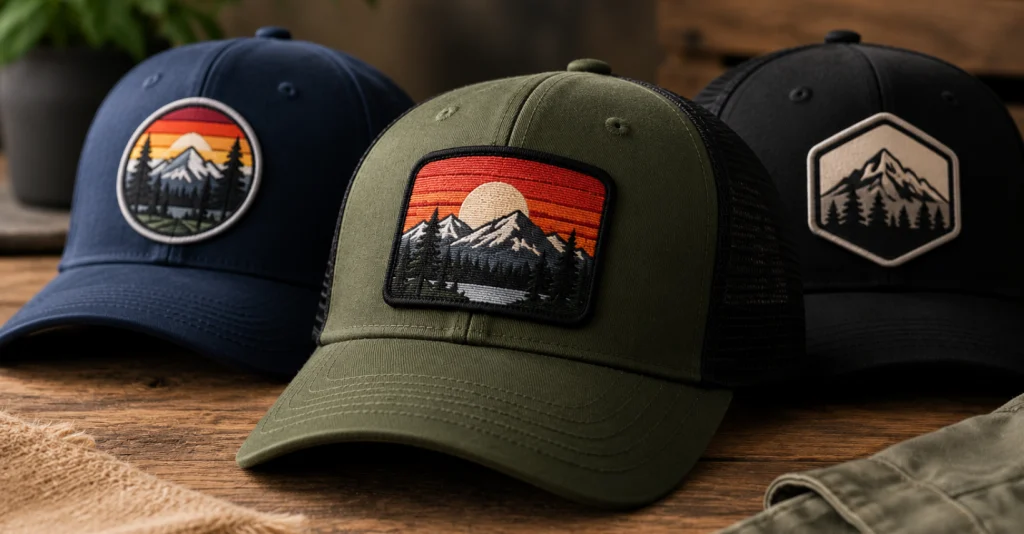
Custom caps have become much more than everyday accessories. For businesses, clothing brands, sports teams, clubs, events, and creative projects, a well-designed cap can become a powerful part of a visual identity. The challenge is finding a decoration method that makes a logo look professional while also fitting the style and construction of the cap.
That is where woven patch caps come in.
Woven patch caps combine the familiar appeal of a custom cap with the clean, detailed appearance of a woven patch. Instead of stitching a logo directly into the cap or using a thick embroidered patch, a woven patch is created by weaving fine threads together to form the artwork. The result is a smooth, relatively flat patch that can reproduce details that may be difficult to achieve with traditional embroidery.
For brands looking for something different from standard embroidered caps, woven patch caps offer an attractive alternative. They can give a cap a refined, modern, label-inspired appearance while still creating a distinctive branded finish.
At Custom Caps Maker UK, we understand that every logo and project has different requirements. The right cap, patch size, construction, colours, and placement can make a major difference to the finished product.
In this guide, we’ll explain what woven patch caps are, how they are made, why brands choose them, how they compare with embroidered caps, and how to design a woven patch that looks great on your finished headwear.
What Are Woven Patch Caps?
Woven patch caps are caps decorated with custom patches made using woven threads rather than traditional embroidery.
The patch is produced by weaving fine threads closely together to create the artwork. Unlike an embroidered patch, where thread is stitched over a fabric base and can create a raised, textured surface, woven construction produces a flatter and smoother finish.
This difference is important because it changes both the appearance and the amount of detail that can be reproduced.
Woven patches are particularly useful for designs containing:
- Small lettering
- Thin outlines
- Detailed logos
- Fine illustrations
- Intricate symbols
- Multiple small design elements
- Clean geometric artwork
- Brand names and taglines
The fine threads used in woven construction allow more detail to fit into a relatively small area. This makes woven patches a strong option for compact cap logos where every millimetre of space matters.
The finished patch can then be attached to a cap using an appropriate application method, depending on the project and intended use.
The result is a cap that looks more like a professionally produced branded product than a generic promotional hat.
Why Are Woven Patch Caps Becoming Popular?
There is no single reason behind the growing interest in woven patch caps.
Part of their appeal comes from the changing way people approach custom headwear. Modern brands often want merchandise that looks like something customers would actually choose to wear—not simply advertising placed on a hat.
A woven patch can help achieve that balance.
The patch becomes part of the design rather than looking like a large advertisement. A carefully designed logo on a structured cap can create a premium, understated appearance.
Woven construction also provides a different visual character from direct embroidery.
Traditional embroidery is known for its raised stitching and dimensional texture. Woven patches, by comparison, have a flatter face with crisp thread-defined artwork.
That makes them especially interesting for:
- Streetwear brands
- Fashion labels
- Start-ups
- Independent businesses
- Outdoor brands
- Coffee shops
- Restaurants
- Sports clubs
- Music merchandise
- Event merchandise
- Corporate giveaways
- Creative agencies
- Community groups
The key is matching the decoration method to the design.
How Are Woven Patches Made?
Understanding how woven patches are produced helps explain why they look different from embroidered patches.
Instead of applying thick embroidery thread over a fabric surface, fine threads are woven together to create the patch itself.
The basic process involves several stages.
1. Artwork Preparation
Everything begins with the artwork.
Your logo, illustration, emblem, lettering, or other design is reviewed to determine how it will translate into a woven patch.
A design that looks perfect on a computer screen may need adjustments before production.
For example, extremely thin lines may need to be slightly increased, tiny gaps may need to be opened, or very small text may need to be adjusted.
The objective is not to change your brand identity.
It is to make sure the artwork works at the actual finished patch size.
2. Colour Planning
Woven patches are produced using thread colours rather than digital screen colours.
This means the artwork needs to be converted into suitable thread colours.
If your logo contains several shades, the design may need careful colour matching to achieve the closest practical result.
Strong contrast is particularly useful for small cap patches.
For example, white lettering on a dark patch background will usually be easier to read than dark lettering placed against a similar dark shade.
3. Digital Conversion
The artwork is then prepared for the weaving process.
This stage translates the visual design into the technical instructions required to create the patch.
The production setup needs to account for:
- Thread direction
- Design density
- Lettering
- Borders
- Shape
- Colour areas
- Fine details
- Finished dimensions
Professional preparation is important because the final patch needs to work as a physical product—not simply as a digital image.
4. Weaving the Patch
Fine threads are woven together to form the patch.
Because the threads are tightly arranged, the surface becomes smooth and compact.
This construction is one of the biggest advantages of woven patches: it allows detailed artwork to be represented within a relatively small area.
5. Cutting and Finishing
Once the patch has been produced, it is cut to the required shape and finished around the edges.
The shape can be:
- Rectangle
- Circle
- Oval
- Shield
- Custom silhouette
- Logo shape
- Badge shape
The border and edge treatment should complement the overall artwork.
A clean border can make a small patch appear more defined and professional.
6. Attaching the Patch to the Cap
The finished woven patch can then be applied to the selected cap.
Depending on the project, the attachment method may vary.
Common options include:
- Sewing
- Heat application
- Iron-on style attachment
- Hook-and-loop backing for suitable applications
- Other custom attachment solutions
The correct choice depends on the cap fabric, expected use, and desired finish.
Woven Patch Caps vs Embroidered Caps
One of the most common questions customers ask is:
Should I choose a woven patch or embroidery for my cap?
There is no universal winner.
The better choice depends on the artwork and the visual effect you want.
Embroidered patches use thicker thread stitched onto a fabric base, which produces the familiar raised and textured appearance. Woven patches use finer threads integrated into the patch structure, creating a flatter surface and allowing greater detail.
Here is a simple comparison:
|
Feature |
Woven Patch Caps | Embroidered Caps |
| Surface | Flat and smooth |
Raised and textured |
|
Fine detail |
Excellent | More limited |
| Small lettering | Often better suited |
May require simplification |
|
Thin lines |
Good for detailed artwork | Can be difficult at small sizes |
| Texture | Subtle |
Strong and dimensional |
|
Overall style |
Modern and refined | Classic and traditional |
| Complex logos | Very suitable |
May need simplification |
|
Bold designs |
Suitable | Excellent |
| Lightweight appearance | Excellent |
More substantial |
|
Cap branding |
Excellent |
Excellent |
The important point is that woven does not mean better and embroidery does not mean worse.
They simply create different results.
If your logo contains small lettering and intricate details, woven may be the better direction. If you want a bold, raised, traditional appearance, embroidery may be more appropriate.
Why Choose Woven Patch Caps?
1. Excellent Fine Detail
One of the strongest advantages of woven patches is their ability to reproduce fine artwork.
Because woven patches use finer threads, they can accommodate details that would be difficult to reproduce with thicker embroidered thread.
This makes them useful for logos featuring:
- Fine outlines
- Detailed icons
- Small symbols
- Intricate lettering
- Compact illustrations
For businesses with detailed branding, this can be a major advantage.
2. Small Logos Can Stay Readable
Caps have limited decoration space.
You cannot simply make a logo larger whenever you have small text.
This is where woven patch caps can be particularly useful.
A tightly woven surface can provide greater definition in a compact patch area, making it possible to preserve more of the original artwork.
However, there is still a practical limit.
No patch manufacturing technique can make microscopic text readable at every size.
Good design decisions are still essential.
3. Smooth, Modern Appearance
Not every brand wants a heavily raised embroidered look.
Some businesses prefer something cleaner and more understated.
Woven patches provide that option.
The flat surface gives the patch a polished appearance that can work particularly well with modern fashion, minimalist branding, and lifestyle products.
4. Lightweight Profile
Compared with heavily embroidered patches, woven patches generally have a lower-profile appearance.
That can be useful when you want the decoration to integrate naturally with the cap rather than dominate the front panel.
For fashion-focused headwear, this subtle approach can create a sophisticated finish.
5. Great for Detailed Branding
Businesses often have logos that contain several components.
For example, a brand logo might include:
Symbol + Brand Name + Tagline + Year
Trying to reproduce all these elements in a small embroidered area may require simplification.
A woven patch can provide more flexibility for detailed artwork.
The final decision should always be based on the actual finished dimensions, but woven construction is worth considering whenever fine detail is important.
What Types of Caps Work With Woven Patches?
Woven patches can be incorporated into many different types of custom headwear.
Baseball Caps
Baseball caps remain one of the most popular choices for custom patches.
A woven patch on the front panel can create a branded look without covering the entire cap with embroidery.
This is especially effective for companies wanting merchandise that customers can wear casually.
Trucker Caps
Trucker caps combine a structured front with mesh panels at the back.
The front panel provides an excellent area for a woven patch.
A detailed patch can become the primary visual feature while the mesh keeps the overall cap relaxed and practical.
5-Panel Caps
Five-panel caps are particularly popular in streetwear and outdoor fashion.
Their clean front panel can work well with compact woven patches.
A simple patch positioned centrally can create a minimalist appearance.
Snapback Caps
Snapbacks caps are another strong option for woven patch branding.
The adjustable closure makes them versatile for promotional merchandise, fashion collections, clubs, and events.
A woven patch can add a distinctive visual element without making the cap feel overly decorated.
Dad Caps
Dad caps have a softer and more casual appearance.
A small woven patch can complement that relaxed style.
Instead of a large logo, consider a compact badge, monogram, symbol, or simple wordmark.
Beanie Caps
Although woven patches are commonly associated with structured headwear, they can also work well on suitable beanies.
Their relatively flat construction can complement the flexible fabric.
For winter brands, outdoor businesses, ski groups, and lifestyle labels, a woven logo patch can provide an attractive alternative to direct embroidery.
Where Should You Place a Woven Patch on a Cap?
Patch placement can dramatically change the personality of a cap.
Front Centre
The front centre is the most recognizable location.
It works particularly well for:
- Brand logos
- Club badges
- Team emblems
- Product branding
- Statement designs
If you want people to immediately notice the logo, front-centre placement is usually the obvious choice.
Side Panel
Side patches are more subtle.
They work well for:
- Small secondary logos
- Flags
- Initials
- Establishment years
- Symbols
A brand can use the front for a primary logo and the side for a smaller secondary mark.
Back
The rear of the cap can also be used for a small patch.
This is useful for:
- Secondary branding
- Short phrases
- Website addresses
- Small symbols
- Collection identifiers
The key is not to overload the cap.
Sometimes one carefully positioned patch looks better than several competing logos.
How Big Should a Woven Patch Be?
There is no single perfect patch size for every cap.
The ideal dimensions depend on:
- Cap style
- Front panel size
- Logo proportions
- Text size
- Artwork complexity
- Desired visual impact
- Placement
A patch that looks perfect on a large trucker cap may feel too large on a low-profile cap.
Likewise, a tiny patch may lose impact on a large structured front panel.
The best approach is to evaluate the artwork at its actual finished size.
Do not judge the design only from a large computer mockup.
A logo may look extremely detailed when displayed at 1,000 pixels wide but become difficult to read when reduced to a small physical patch.
How to Design a Great Woven Patch for Caps
Keep Your Main Message Clear
A cap is normally viewed from a distance.
Your main logo or message should therefore be easy to recognize.
Avoid filling every available space with unnecessary information.
If the brand name is the most important element, make it the focus.
Use Strong Contrast
Contrast helps small details remain visible.
Consider combinations such as:
- Black and white
- Navy and white
- Red and white
- Dark green and cream
- Brown and beige
Your colour choices should also complement the colour of the cap.
A patch should look like part of the cap not something randomly placed on top of it.
Be Careful With Tiny Text
Woven patches are excellent for detailed designs, but tiny text still has limitations.
If a phrase is too small, it may become difficult to read even with fine woven threads.
Ask yourself:
Does this text actually need to be included?
If the answer is no, removing it may create a stronger design.
Simplify Where Necessary
Simplification does not mean destroying your logo.
It means adapting it for the physical application.
You might:
- Remove unnecessary outlines
- Increase spacing
- Thicken extremely thin elements
- Reduce tiny decorative details
- Shorten a tagline
- Increase letter spacing
These small adjustments can make a significant difference.
Woven Patch Caps for Businesses
For businesses, custom caps can work as wearable branding.
Instead of relying only on traditional advertising, companies can create merchandise that customers, staff, or event attendees can actually use.
Woven patch caps are particularly useful for businesses that want a polished and contemporary identity.
Potential applications include:
Restaurants and Cafés
A branded cap can become part of staff clothing or merchandise.
Construction and Trades
Teams can use branded caps to create a consistent professional appearance.
Outdoor Businesses
Adventure companies, hiking brands, camping businesses, and outdoor retailers can use woven badges to reinforce their identity.
Fashion Brands
A custom woven patch can create a boutique-style appearance that feels more like a retail product than promotional merchandise.
Start-Ups
A small logo patch can provide an understated way to introduce a new brand.
Events
Festivals, conferences, competitions, and charity events can create limited-edition patch caps for attendees.
Woven Patch Caps for Clothing Brands
For fashion brands, the details matter.
A cap may be one of the first accessories customers notice.
A poorly chosen logo placement can make a premium cap look ordinary. A carefully designed patch can have the opposite effect.
Woven patches are particularly useful for brands that want:
- Clean branding
- Detailed logos
- Small labels
- Limited-edition collections
- Minimalist designs
- Premium merchandise
- Streetwear aesthetics
You can also create different patch designs for different collections.
For example:
Collection 01: Main logo
Collection 02: Monogram
Collection 03: Seasonal badge
Collection 04: Limited-edition artwork
This approach allows the same cap style to become part of an evolving product range.
Woven Patch Caps for Teams and Clubs
Woven patches can also be useful for groups.
Sports teams, cycling clubs, motorcycle groups, hiking communities, university societies, and social organisations can all create custom patch caps.
A patch can contain:
- Club name
- Team name
- Mascot
- Established year
- Location
- Symbol
- Member designation
Because woven patches can handle detailed designs, they are particularly useful for badges containing multiple visual elements.
Woven Patch Caps for Events and Promotions
Promotional caps do not have to look like conventional promotional merchandise.
A large company logo printed across the front can sometimes make a hat feel like an advertisement.
A small woven badge can provide a more subtle alternative.
For example, a company might create:
Company Logo + 2026 Event
or
Event Symbol + Location
This turns the cap into a keepsake rather than simply a marketing item.
If attendees actually want to wear the cap after the event, the branding has the potential to continue working long after the event has ended.
Are Woven Patch Caps Durable?
Durability depends on the quality of the patch, construction, attachment method, cap fabric, and how the finished product is used and maintained.
Woven patches are tightly constructed, which gives them good structural stability. However, embroidered patches can have an advantage in certain heavy-abrasion applications because their thicker stitched surface creates a more rugged, textured construction.
For everyday cap use, the important thing is to choose a suitable production method and attachment system for the intended application.
Good care also matters.
Follow the care instructions associated with the finished cap and patch, particularly when cleaning the product.
Woven Patch Caps vs Direct Cap Embroidery
Another important comparison is woven patches versus direct embroidery.
With direct embroidery, the design is stitched directly into the cap.
With a woven patch, the artwork is produced separately and then attached to the cap.
Direct Embroidery
Best when you want:
- Traditional branding
- Raised stitching
- A clean integrated appearance
- Bold logos
- Minimal artwork
Woven Patch
Best when you want:
- Detailed artwork
- Small lettering
- A badge-like appearance
- A separate branded element
- A smooth surface
Neither method is automatically better.
The right choice depends on your brand and artwork.
Woven Patch Caps vs Printed Caps
Printed caps are another alternative.
Printing can reproduce complex colours and photographic-style artwork more easily than thread-based decoration.
However, printed decoration creates a very different visual experience.
A woven patch gives your cap a physical badge element.
It can feel more substantial and collectible.
For brands that want their headwear to have a tactile component without the raised texture of embroidery, woven patches can occupy an interesting middle ground.
How to Choose the Right Cap for a Woven Patch
The patch is only one part of the finished product.
The cap itself matters just as much.
Consider:
Cap Structure
A structured cap can provide a strong foundation for a front patch.
Fabric
Cotton, polyester, canvas, and performance fabrics can create very different looks.
Crown Shape
The patch needs to work with the shape and curvature of the front panel.
Colour
Choose a cap colour that supports the patch rather than competing with it.
Closure
Snapback, buckle, strapback, and fitted designs each create a different overall style.
Intended Use
A fashion cap may require a different design approach from a workwear or outdoor cap.
Common Mistakes When Ordering Woven Patch Caps
Mistake 1: Using an Oversized Patch
A patch that is too large can overwhelm the cap.
The design should have enough breathing room around it.
Mistake 2: Making Text Too Small
Woven construction allows excellent detail, but there are still physical limits.
Always test small text at actual size.
Mistake 3: Ignoring the Cap Shape
A patch that looks good on a flat artwork template may behave differently once placed on a curved cap panel.
Consider the physical shape before approving the final design.
Mistake 4: Using Too Many Colours
More colours do not automatically make a design better.
A controlled colour palette often produces a stronger brand identity.
Mistake 5: Choosing Decoration Before Artwork
Instead of deciding, “I want embroidery” or “I want a woven patch” before looking at the logo, start with the artwork.
Ask:
What decoration method will reproduce this design best?
That simple change in thinking can prevent disappointing results.
How Custom Caps Maker UK Can Help
Creating a successful woven patch cap involves more than putting a logo onto a hat.
You need to consider the relationship between:
Logo + Patch + Cap + Size + Placement + Colour + Construction
At Custom Caps Maker UK, the goal is to help turn your branding idea into finished custom headwear that looks intentional and professional.
Whether you are creating caps for a business, clothing line, team, event, club, or personal project, the design should reflect what the cap is actually going to be used for.
A good custom cap should not simply display a logo.
It should make that logo look right.
How to Order Custom Woven Patch Caps
The process can be straightforward when you have your basic requirements ready.
Step 1: Prepare Your Logo
Send your logo or artwork in the highest-quality format available.
Vector artwork is particularly useful when available.
Step 2: Decide on the Cap Style
Choose the type of cap that fits your brand.
For example:
- Baseball cap
- Trucker cap
- Snapback
- 5-panel cap
- Dad cap
- Other custom styles
Step 3: Choose the Patch Style
If your logo contains fine details or small lettering, consider a woven patch.
If you want a bold, raised appearance, embroidered decoration may be more appropriate.
Step 4: Select Your Colours
Think about both the patch colours and the base cap colour.
They should work together.
Step 5: Determine Size and Placement
The patch should be sized according to the actual front panel and artwork.
Front-centre placement is popular, but side and rear placement can also create distinctive results.
Step 6: Review the Mockup
Before production, carefully review the proposed design.
Check:
- Logo proportions
- Text readability
- Patch dimensions
- Colour contrast
- Placement
- Overall cap appearance
Step 7: Move Into Production
Once the design has been approved, the cap and patch can move into production according to the agreed specifications.
Are Woven Patch Caps Right for Your Brand?
If your goal is to create custom headwear with a clean, detailed, modern appearance, woven patch caps are definitely worth considering.
They can be particularly effective when your logo contains fine lines or compact lettering that would need to be simplified for traditional embroidery.
At the same time, if your priority is a raised, tactile, traditional patch appearance, embroidered decoration may be the better choice. Woven patches trade some of that dimensional texture for a flatter surface and greater detail potential.
The best choice is ultimately the one that makes your artwork look strongest on the finished cap.
Final Thoughts: Create a Cap People Actually Want to Wear
Custom headwear is most effective when it looks like a real product rather than an afterthought.
That is why the decoration method matters.
Woven patch caps offer brands a way to combine detailed artwork with a smooth, modern patch finish. They can work particularly well for logos that contain small elements, intricate graphics, or compact lettering.
From fashion brands and cafés to outdoor companies, sports clubs, events, and independent businesses, woven patch caps can turn a simple piece of headwear into a recognizable part of a brand identity.
The most important thing is to design for the finished product.
Think about the cap style.
Think about the patch dimensions.
Think about readability.
Think about colour contrast.
Think about where the cap will be worn.
And most importantly, choose a decoration method that works with your actual artwork.
If you are looking to create custom woven patch caps for your brand, Custom Caps Maker UK can help you develop a cap and patch combination designed around your requirements.
A well-made cap does more than carry a logo.
It gives your brand something people can wear, remember, and make part of their everyday style.