
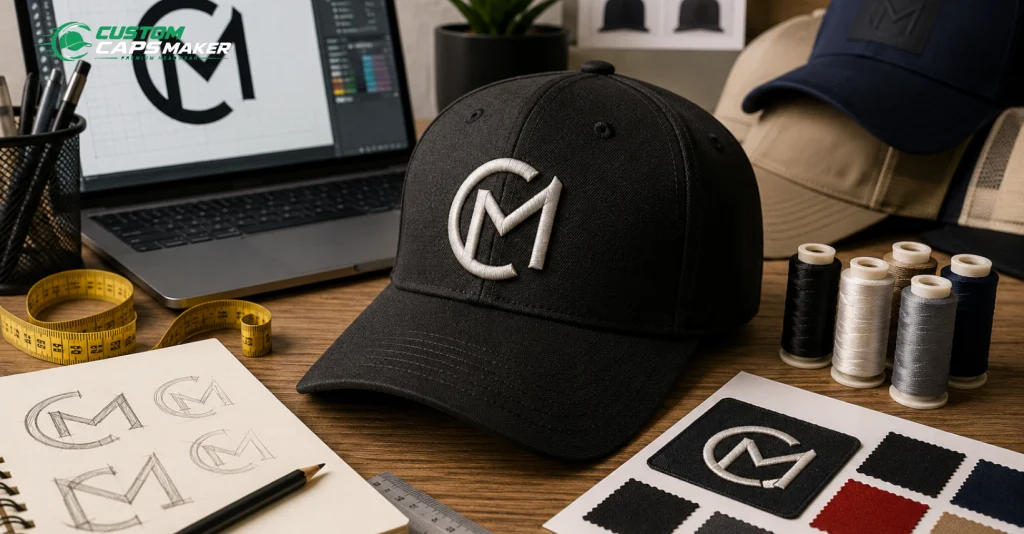
A great logo can turn an ordinary cap into a powerful piece of branded merchandise. Whether you are building a new fashion label, promoting a business, creating merchandise for a sports team, or simply designing personalised headwear, your logo is often the first thing people notice. A well-designed custom cap logo can communicate your identity, make your products more memorable, and help you create a consistent visual presence wherever your caps are worn.
However, designing a logo specifically for a cap is different from creating a logo for a website, business card, or social media profile. Caps have limited decoration space, curved surfaces, different fabric textures, and specific production requirements. A design that looks perfect on a computer screen may not always translate well into embroidery, patches, or printing.
That is why the process of creating a custom cap logo should involve more than simply placing your existing logo on the front of a hat.
At Custom Caps Maker, we help brands, businesses, teams, creators, and organisations bring their ideas to life through high-quality custom headwear. From embroidered caps and baseball caps to trucker caps, snapbacks, fitted caps, dad caps, 5-panel caps, 6-panel caps, military caps, and beanies, the right logo and decoration method can transform your headwear into something people genuinely want to wear.
In this guide, we will explain how to create a custom cap logo from the initial idea to the final production stage, including choosing the right design, selecting colours, preparing artwork, deciding between embroidery and printing, choosing logo placement, and avoiding common mistakes.
What Is a Custom Cap Logo?
A custom cap logo is a personalised visual design applied to a cap to represent a brand, company, organisation, team, event, or individual identity.
It may include:
- A company logo
- A brand symbol
- A monogram
- A wordmark
- A team emblem
- A mascot
- A slogan
- Initials
- A creative illustration
- A combination of text and graphics
The logo can be applied using several different techniques, including traditional embroidery, 3D puff embroidery, printed graphics, heat transfer, or custom patches.
The best option depends on the type of artwork, cap style, desired appearance, budget, and intended use.
For example, a premium clothing brand may choose a minimalist embroidered logo on a structured cap, while a sports team may prefer a bold 3D embroidered emblem. A company attending a trade show might choose printed promotional caps, while a streetwear label could use a woven or leather patch for a distinctive finish.
The key is to create a logo that works specifically for headwear rather than simply treating the cap as another flat marketing surface.
Why Is a Good Cap Logo Important?
A cap is more than an accessory. When your logo is placed on a cap, it becomes a mobile representation of your identity.
Someone wearing your branded cap may be seen by dozens or even hundreds of people during the day. This makes custom caps useful for businesses, fashion brands, sports teams, promotional campaigns, events, and communities.
A strong custom cap logo can help you:
Build Brand Recognition
A memorable logo allows people to identify your brand quickly. When your logo appears consistently across caps, clothing, packaging, websites, and social media, it becomes easier for customers to recognise your business.
Create Professional Merchandise
Branded caps can give your business a polished and professional appearance. Staff members wearing matching caps can create a more consistent look, while branded merchandise can strengthen your overall marketing strategy.
Strengthen Team Identity
Sports clubs, schools, gyms, outdoor groups, and community organisations can use custom cap logos to create a sense of belonging.
A shared logo can make members feel connected while giving the group a recognisable identity.
Promote Your Fashion Brand
For clothing and streetwear brands, caps can become an important part of a merchandise collection. A simple logo embroidered onto a quality cap can create a clean, premium product that customers can wear every day.
Increase Visibility
Unlike many traditional promotional products that remain in offices or homes, caps are designed to be worn. This means your logo can travel with the customer and appear in different environments.
Step 1: Define the Purpose of Your Custom Cap Logo
Before designing anything, decide why you are creating the logo.
This is one of the most important steps because the purpose of the cap will influence almost every design decision.
Ask yourself:
- Is the cap for a business?
- Is it for a clothing brand?
- Is it for a sports team?
- Is it for employees?
- Is it promotional merchandise?
- Is it for a special event?
- Is it part of a fashion collection?
- Is it a personal project?
- Is it intended as a gift?
For example, a corporate logo may need to look professional and simple. A fashion brand may want a more creative and visually distinctive design. A sports team may benefit from a bold emblem that is easy to recognise from a distance.
Understanding your audience is equally important.
Think about who will wear the cap and what kind of style they prefer. A minimalist logo may appeal to a premium fashion audience, while younger streetwear customers may prefer oversized lettering, bold graphics, or distinctive patches.
Your logo should not only represent your brand. It should also look natural on the type of cap your customers actually want to wear.
Step 2: Start With Your Existing Brand Identity
If you already have a business logo, you may not need to create an entirely new design.
Instead, consider adapting your existing identity for headwear.
Your website logo may contain:
- Small text
- Fine lines
- Multiple colours
- Detailed illustrations
- Complex gradients
- Tiny design elements
Some of these features may not translate effectively into embroidery.
For example, extremely small lettering can become difficult to read when stitched onto a cap. Thin lines may lose definition, while complicated artwork can become visually crowded when reduced to a small size.
This does not mean your logo cannot be used.
It simply means you may need a simplified version for your cap.
Many successful brands maintain multiple logo variations, such as:
- Full logo
- Simplified logo
- Icon or symbol
- Monogram
- Wordmark
A cap often works best with a simplified logo or recognisable symbol.
Step 3: Choose a Simple and Recognisable Design
When it comes to custom cap logos, simplicity is often an advantage.
A cap has a relatively small decoration area, especially on the front panel. Your logo needs to remain clear even when viewed from a distance.
A strong cap logo usually has:
- Clear shapes
- Strong contrast
- Simple typography
- Balanced proportions
- Recognisable symbols
- Limited unnecessary details
Consider famous logos used on hats and other apparel. Many of the most recognisable designs can be understood almost instantly.
Your goal should be to create something that remains identifiable without requiring someone to study it.
If your logo contains a complex illustration, ask whether the most important elements can be simplified.
For example, instead of using a highly detailed animal illustration, you could create a clean silhouette. Instead of placing a long sentence on the front of a cap, you might use initials or a short brand name.
The simpler the design, the easier it may be to reproduce consistently across different decoration methods.
Step 4: Select the Right Typography
Typography can make or break a custom cap logo.
If your design includes text, choose a font that remains readable at the final production size.
Popular typography styles include:
Sans Serif Fonts
Clean and modern, sans serif fonts are often ideal for contemporary businesses and fashion brands.
Serif Fonts
Serif typography can create a more traditional, sophisticated, or heritage-inspired appearance.
Script Fonts
Script fonts can add personality and elegance, although extremely detailed scripts may be difficult to embroider.
Bold Display Fonts
Bold fonts are suitable for sports teams, streetwear brands, and logos that need strong visual impact.
Custom Lettering
Unique lettering can make your brand more distinctive. Custom typography is particularly useful when you want your logo to feel exclusive.
When selecting a font, avoid designs that are too thin or complicated for the intended decoration method.
For embroidery, thicker letterforms are often easier to reproduce clearly than delicate typography.
If your brand name is long, consider using an abbreviation or monogram for the cap. This can create a cleaner design while still maintaining brand recognition.
Step 5: Choose Your Logo Colours Carefully
Colour plays a major role in how your custom cap logo looks.
Start with your existing brand colours if you already have established branding. Consistency across your marketing materials can make your business appear more professional.
However, you should also consider the colour of the cap itself.
A black logo on a black cap may look subtle, while a white logo on black can create a high-contrast appearance.
Some popular combinations include:
- Black cap with white logo
- White cap with black logo
- Navy cap with white embroidery
- Green cap with cream logo
- Red cap with white design
- Beige cap with dark brown logo
- Black cap with gold embroidery
There is no single perfect colour combination.
The right choice depends on your brand identity and the visual effect you want to achieve.
For premium branding, you might choose a subtle tone-on-tone logo. For promotional purposes, a high-contrast design may be more effective because it is easier to notice.
Always think about how the colours will appear on the actual cap material rather than judging them only on a computer screen.
Step 6: Decide Between Embroidery, Printing, and Patches
Once your logo is ready, you need to choose the right customization technique.
At Custom Caps Maker, different decoration options can help you achieve different visual effects, including embroidery, printing, and custom patches.
Custom Embroidery
Embroidery is one of the most popular choices for cap logos.
The design is created using stitched threads, giving the logo a textured and premium appearance.
Embroidered logos work particularly well for:
- Businesses
- Fashion brands
- Sports teams
- Workwear
- Corporate merchandise
- Promotional caps
- Lifestyle brands
Embroidery is especially effective when your logo is relatively simple and uses bold shapes.
It can create a professional finish that feels integrated into the cap rather than simply printed onto the surface.
3D Puff Embroidery
If you want your logo to stand out physically, 3D puff embroidery can create a raised appearance.
This technique can be particularly effective for:
- Streetwear brands
- Sports teams
- Baseball-style caps
- Bold initials
- Large lettering
However, not every logo is suitable for 3D puff embroidery. Extremely fine details and small text may not produce the desired result.
Printed Logos
Printing can be a useful option when your artwork includes more complex visual details.
Printed designs may be suitable for:
- Detailed graphics
- Multiple colours
- Gradients
- Complex illustrations
- Promotional artwork
Printing can provide greater flexibility for certain types of artwork.
Custom Patches
Patches provide another way to display your logo.
Depending on your desired appearance, you might choose:
- Embroidered patches
- Woven patches
- PVC patches
- Leather patches
Patches can give caps a distinctive identity and may be particularly attractive for fashion brands, outdoor businesses, clubs, and streetwear collections.
A patch can also make your logo feel like a separate design element rather than a standard embroidered mark.
Step 7: Choose the Right Cap Style for Your Logo
Your logo should complement the cap itself.
Different cap styles provide different design opportunities.
Baseball Caps
Classic baseball caps are versatile and work well with front-centre logos. They are suitable for businesses, teams, casual fashion, and promotional merchandise.
Trucker Caps
Trucker caps feature a breathable mesh back and often have a larger front panel. They can work particularly well with bold logos and patches.
Snapback Caps
Snapbacks have a modern, structured appearance and are popular in streetwear and lifestyle fashion. Large embroidered logos can create a strong visual impact.
Dad Caps
Dad caps offer a relaxed, casual appearance. Minimal logos, small embroidery, and simple typography often work beautifully with this style.
Fitted Caps
Fitted caps provide a clean and structured silhouette. Bold front embroidery can create a premium appearance.
5-Panel Caps
Five-panel caps have a distinctive shape that works well for modern fashion, outdoor brands, and streetwear designs.
6-Panel Caps
Six-panel caps offer a classic structure and are highly versatile for branding.
Military Caps
Military-inspired caps can complement rugged logos, outdoor branding, and heritage-inspired designs.
Beanies
If your logo needs to be applied to winter headwear, a patch or embroidered design can provide a stylish branding solution.
The important point is that the logo and cap should be designed together.
A design that looks excellent on a structured snapback may need to be adjusted for a soft, low-profile dad cap.
Step 8: Decide Where to Place Your Logo
The front centre is the most common location for a custom cap logo, but it is not your only option.
Front Centre
This is the most visible position and is ideal for:
- Company logos
- Brand names
- Team logos
- Fashion labels
- Main promotional branding
Side
Side embroidery is useful for secondary branding.
You could place:
- Initials
- A small icon
- A slogan
- A founding year
- A social media handle
Back
The back area can be used for additional information or branding.
For example, you might place your main logo at the front and a small slogan or website name at the back.
Under the Brim
For some cap designs, the underside of the brim can provide a subtle opportunity for additional branding or creative artwork.
However, placement should always be considered in relation to the cap’s construction and decoration method.
If you are ordering custom caps for your brand, think about whether you want one primary logo or a combination of branding elements.
For many businesses, a simple front logo creates the cleanest and most professional appearance.
Step 9: Prepare Your Logo Artwork
Once you have decided on your design, prepare your artwork for production.
Professional file formats such as AI, EPS, PDF, and SVG are commonly useful for scalable artwork. High-resolution PNG files may also be suitable depending on the customization process.
The most important thing is to provide artwork that is clear and easy to reproduce.
Before submitting your design, check:
- Are all words spelled correctly?
- Is the logo high resolution?
- Are colours clearly defined?
- Are there unnecessary details?
- Is the design readable at the intended size?
- Does the artwork have sufficient contrast?
- Are fonts converted to outlines where appropriate?
- Is the background removed if necessary?
If you are unsure whether your logo is suitable for production, professional guidance can help.
At Custom Caps Maker, the design and mockup stage allows customers to review how their artwork will look on the finished headwear before production begins.
Step 10: Consider Embroidery Digitisation
If you choose embroidery, your artwork needs to be converted into a stitch-ready format.
This process is called digitisation.
Digitisation determines how the embroidery machine will reproduce your logo using stitches.
The process involves decisions about:
- Stitch direction
- Stitch density
- Thread colours
- Underlay
- Stitch types
- Lettering size
- Design dimensions
A professionally digitised logo can make a significant difference to the final result.
Two logos may look identical in a digital preview but produce different embroidery results depending on how the artwork is digitised.
This is particularly important when working with small text, curved lines, detailed symbols, or intricate artwork.
Step 11: Create a Digital Mockup Before Production
One of the best ways to avoid mistakes is to review a digital mockup before manufacturing begins.
A mockup allows you to see:
- The logo size
- Logo placement
- Cap colour
- Thread colours
- Overall proportions
- Front and side branding
- The relationship between the logo and cap style
This stage gives you the opportunity to make adjustments before production.
Perhaps the logo looks too small.
Maybe the colours do not contrast enough.
Perhaps the design would look better slightly higher on the front panel.
A digital mockup allows these changes to be considered before the final caps are manufactured.
At Custom Caps Maker, the process is designed to make custom cap ordering straightforward, from sharing your initial vision and receiving a personalised design concept to approving the mockup and moving into production.
Step 12: Make Sure Your Logo Is the Right Size
Logo size is one of the most important considerations in cap design.
A logo that is too small may become difficult to notice.
A logo that is too large may look crowded or overwhelm the cap.
The ideal size depends on:
- Cap style
- Front panel dimensions
- Logo shape
- Decoration method
- Artwork complexity
- Intended visual effect
A horizontal logo may require a different size than a circular emblem.
A small monogram might look excellent on a dad cap, while a bold sports emblem may need more space on a structured baseball cap.
Instead of asking for the largest possible logo, focus on achieving visual balance.
Your logo should feel like it belongs on the cap.
Step 13: Think About Contrast and Visibility
A beautiful logo is not useful if people cannot see it.
Contrast is especially important for embroidery.
Imagine placing dark blue embroidery on a black cap. The result may be subtle and sophisticated, but it will not have the same visibility as white embroidery.
Neither option is necessarily wrong.
The question is what you want your logo to achieve.
Choose strong contrast when you want maximum visibility.
Choose low contrast when you want a more understated, premium appearance.
For fashion brands, tone-on-tone branding can create a sophisticated aesthetic.
For promotional campaigns, stronger contrast may help your brand attract more attention.
Step 14: Avoid Overloading Your Cap With Information
One of the most common custom cap design mistakes is trying to include too much information.
A cap is not a brochure.
You generally do not need to include:
- Your full address
- Long paragraphs
- Multiple phone numbers
- Several slogans
- Too many icons
- Excessive decorative elements
Instead, focus on one primary message.
For a business, this could be the company logo.
For a sports team, it could be the team emblem.
For a fashion brand, it could be the brand name or signature symbol.
If you need additional information, consider placing it on the side or back.
The goal is to create a cap that people actually want to wear.
Step 15: Match the Logo to Your Audience
Your target audience should influence your logo design.
A premium corporate audience may prefer:
- Minimalist logos
- Clean typography
- Neutral colours
- Subtle embroidery
A streetwear audience may prefer:
- Bold graphics
- Large lettering
- 3D puff embroidery
- Woven patches
- Strong colour combinations
A sports audience may respond well to:
- Team colours
- Mascots
- Bold typography
- Athletic symbols
An outdoor audience may prefer:
- Nature-inspired graphics
- Heritage-style typography
- Earth tones
- Durable patch designs
Your cap should feel appropriate for the people who will wear it.
Step 16: Design for Real-World Wear
A cap logo should look good not only in photographs but also in everyday life.
Think about where your caps will be worn.
Will customers wear them:
- At sporting events?
- On the high street?
- At work?
- At festivals?
- While travelling?
- Outdoors?
- At promotional events?
The logo needs to remain visually effective in different environments.
This is another reason to prioritise clarity and strong design.
A simple logo that remains recognisable from several metres away can often have more impact than a complicated design that only looks impressive up close.
Common Mistakes to Avoid When Creating a Custom Cap Logo
Creating a custom cap logo is exciting, but several mistakes can affect the final result.
Using Extremely Small Text
Small text may become difficult to read, especially with embroidery.
If your business name is long, consider using a shorter version or a recognisable symbol.
Choosing Too Many Colours
A logo with too many colours can look complicated.
It may also increase production complexity depending on the decoration method.
Ignoring the Cap Style
A logo should be designed with the cap in mind.
Consider the shape, structure, material, and available decoration area.
Using Low-Resolution Artwork
Blurry artwork can create problems during production.
Whenever possible, provide high-quality, professional artwork.
Skipping the Mockup Stage
Never rush directly into production without reviewing how the logo will look on the actual cap style.
A mockup can help identify problems before manufacturing.
Making the Logo Too Large
Bigger does not always mean better.
Your logo should have enough space around it to breathe.
Making the Logo Too Small
A logo that disappears into the cap will not provide strong branding.
Make sure the design remains visible and recognisable.
Ignoring Colour Contrast
Always consider how your thread, print, or patch colour interacts with the cap colour.
Forgetting Future Reorders
If you plan to reorder caps later, keep your final artwork and production specifications organised.
Consistency is important for long-term branding.
How to Create a Custom Cap Logo With Custom Caps Maker
Once your logo concept is ready, ordering your custom headwear should be straightforward.
At Custom Caps Maker, the process begins with understanding your requirements.
You can share details such as:
- Your preferred cap style
- Quantity
- Logo or artwork
- Cap colour
- Decoration method
- Size requirements
- Custom placement
- Any special instructions
The next step is the design and mockup stage.
Your logo can be positioned on the selected cap style so you can review the overall appearance before production.
Once the design is approved, the manufacturing process begins.
Depending on your requirements, your cap may feature embroidery, printed artwork, or a custom patch. The goal is to create headwear that combines quality materials, comfortable construction, professional branding, and a finished appearance that represents your identity.
Custom Cap Logo Ideas for Different Businesses
If you are still deciding what your logo should look like, consider these ideas.
For Clothing Brands
Use a minimal wordmark, monogram, or distinctive symbol.
For Restaurants and Cafés
Consider a simple illustrated icon combined with your brand name.
For Construction Companies
Bold typography and strong symbols can create a professional appearance.
For Sports Teams
Use mascots, team initials, or an emblem featuring your official colours.
For Gyms and Fitness Brands
Bold lettering and athletic symbols can create a powerful visual identity.
For Outdoor Brands
Nature-inspired imagery, mountains, trees, animals, and heritage-style designs can work well.
For Events
Use the event name, year, and a memorable symbol.
For Personal Projects
Initials, nicknames, or custom artwork can create a unique personalised cap.
How Much Does It Cost to Create a Custom Cap Logo?
The total cost of custom caps depends on several factors.
These may include:
- Cap style
- Material
- Order quantity
- Logo size
- Number of decoration locations
- Embroidery complexity
- Number of thread colours
- Patch type
- Printing method
- Additional customisation
For example, a simple embroidered logo on a standard cap may have different production requirements from a large, multi-colour embroidered design with additional side branding.
Ordering larger quantities can also affect the per-unit price.
The best approach is to provide your requirements and request a personalised quote based on your exact project.
Should You Create a New Logo or Use Your Existing Logo?
There is no universal answer.
If your existing logo is simple, recognisable, and suitable for embroidery or printing, you may be able to use it directly.
If your logo is complex, you may benefit from creating a simplified cap version.
For example, your website may use a full logo with a symbol and long company name, while your cap could feature only the symbol or initials.
This approach allows you to maintain brand recognition while adapting your identity to the physical limitations of headwear.
The important thing is to keep the visual connection between the two versions.
Your cap logo should still feel like part of the same brand.
Tips for Creating a Logo People Actually Want to Wear
A promotional cap becomes more valuable when people genuinely enjoy wearing it.
Instead of designing a cap that looks like an advertisement, consider creating something that feels like fashion.
Keep the branding clean.
Choose a quality cap style.
Use colours that complement everyday outfits.
Avoid overcrowding the design.
Think about how the cap will look from the front, side, and back.
Consider whether your customers would wear it even if your business name were not involved.
This mindset can help you create merchandise that has a longer lifespan.
A well-designed cap may continue to be worn long after a promotional event has ended, giving your brand additional visibility.
Final Checklist Before Ordering Custom Caps
Before approving your design, review the following checklist:
Logo
- Is the logo clear?
- Is it recognisable?
- Does it represent your brand?
- Is the artwork high quality?
Typography
- Is the text readable?
- Is the font appropriate?
- Is the lettering large enough?
Colours
- Do the colours match your brand?
- Is there enough contrast?
- Will the colours work with the cap?
Placement
- Is the logo positioned correctly?
- Is the size balanced?
- Would side or back branding improve the design?
Production
- Is the artwork suitable for embroidery or printing?
- Does the design need digitisation?
- Have you reviewed a mockup?
Cap Style
- Does the cap suit your audience?
- Does the logo work with the cap’s shape?
- Is the material appropriate for your intended use?
Quantity
- How many caps do you need?
- Are you ordering different colours or sizes?
- Do you need a sample before placing a larger order?
Taking a few extra minutes to review these details can help you achieve a much better final product.
Why Choose Custom Caps Maker for Your Custom Logo Caps?
Creating a custom cap is about more than putting a logo onto a hat.
It is about combining your brand identity with the right cap style, decoration technique, colours, placement, and materials to create something that looks professional and feels worth wearing.
At Custom Caps Maker, we help turn ideas into custom headwear designed for businesses, brands, sports teams, events, organisations, and individuals. Our range includes multiple cap styles and customisation options, allowing you to create headwear that matches your specific requirements.
From the first concept to the final production stage, careful attention to artwork, mockups, materials, and decoration can make a significant difference.
Whether you want a classic embroidered baseball cap, a bold snapback with 3D puff embroidery, a breathable trucker cap with a custom patch, a relaxed dad cap with minimalist branding, or another personalised headwear style, the right logo can become the defining feature of your design.
Create Your Custom Cap Logo Today
A great custom cap logo does not need to be complicated.
It needs to be recognisable, readable, well-balanced, and suitable for the way it will be produced.
Start by defining your purpose. Understand your audience. Simplify your design where necessary. Choose colours carefully. Select the right decoration method. Pick a cap style that complements your identity. Then review a digital mockup before production.
When these elements work together, your custom caps can become more than promotional products. They can become part of your brand identity.
Whether you are launching a new clothing label, upgrading your company merchandise, creating teamwear, preparing for an event, or developing a new fashion collection, Custom Caps Maker can help you bring your concept to life with personalised headwear designed around your vision.
Ready to turn your logo into a cap people will want to wear?
Start by sharing your logo, preferred cap style, and customisation requirements with Custom Caps Maker. With the right design and professional production, your next cap can become a powerful representation of your brand—one that people can see, wear, and remember wherever they go.
Frequently Asked Questions About Custom Cap Logos
1. Can I use my existing business logo on a custom cap?
Yes. Existing logos can often be adapted for custom caps using embroidery, printing, or patches. However, complex designs may need to be simplified to achieve the best result.
2. What is the best logo style for an embroidered cap?
Simple logos with clear shapes, bold typography, and limited fine details are generally well suited to embroidery.
3. Can I create a custom cap logo from scratch?
Yes. You can create a new logo specifically for your cap collection or adapt your existing brand identity for headwear.
4. Is embroidery better than printing for cap logos?
It depends on your design and goals. Embroidery provides a textured, premium appearance, while printing can be useful for detailed artwork and complex graphics.
5. Can I put my logo on the side of a cap?
Yes. Side embroidery can be used for secondary logos, initials, slogans, or other small branding elements, depending on the cap style.
6. Can I put a custom patch on my cap?
Yes. Custom patches can provide an alternative to direct embroidery or printing. Options may include embroidered, woven, PVC, and leather patches.
7. Do I need a high-resolution logo?
High-quality artwork is recommended for the best production results. Vector files such as AI, EPS, PDF, and SVG can be particularly useful for scalable artwork.
8. Can I see what my cap will look like before production?
A digital mockup or design proof can help you review the logo placement, size, colours, and overall appearance before production begins.
9. What cap style is best for a custom logo?
There is no single best style. Baseball caps, snapbacks, trucker caps, dad caps, fitted caps, 5-panel caps, and 6-panel caps can all work well depending on your brand and audience.
10. Can I order custom caps in different colours?
Depending on your project and product specifications, you may be able to mix different cap colours, styles, and sizes within your order.
11. Are custom logo caps suitable for businesses?
Absolutely. Custom logo caps can be used for staff uniforms, promotional merchandise, corporate events, trade shows, customer giveaways, and branded retail collections.
12. How do I get started?
Start by choosing your cap style and preparing your logo or artwork. Then share your requirements with Custom Caps Maker so the design, customisation method, and production details can be discussed before your order moves into production.