
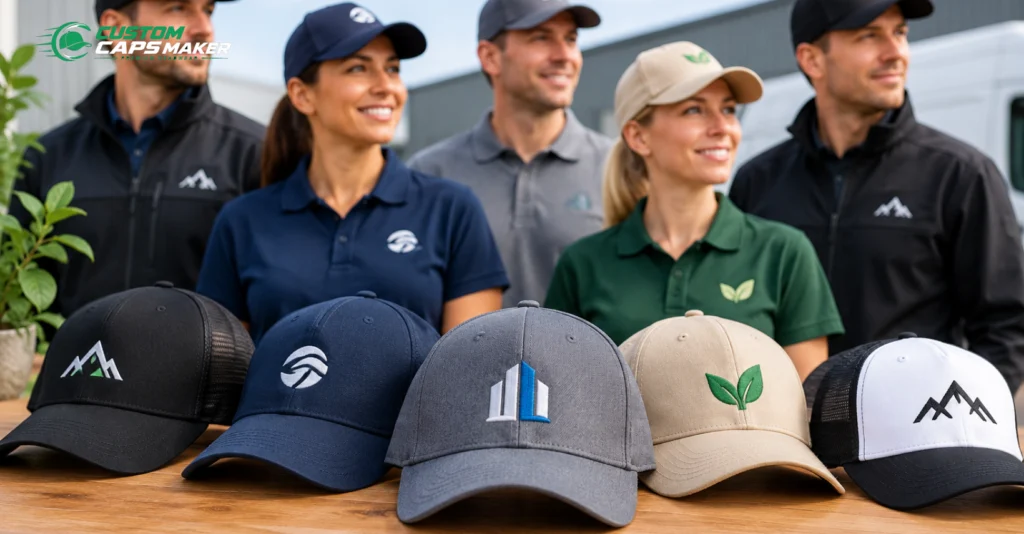
A company uniform is more than a collection of clothing worn by employees. It is part of how customers recognise your business, how employees present themselves, and how consistently your brand appears in public. While shirts, jackets, trousers, and hi-vis workwear often receive most of the attention, caps can be an equally useful part of a professional company uniform.
The right branded cap can complete an employee’s outfit while providing practical benefits such as shade, comfort, and additional brand visibility. It can be particularly useful for outdoor workers, construction teams, delivery staff, event teams, hospitality businesses, sports organisations, landscaping companies, and businesses that regularly work in public.
However, choosing company uniform caps is not simply a matter of selecting a colour and adding a logo. You need to consider the cap style, material, fit, branding method, logo size, working environment, comfort, durability, and the way the cap will work alongside the rest of your uniform.
This guide explains how to choose caps for your company uniform and what businesses should consider before ordering custom caps for their teams.
Why Add Caps to a Company Uniform?
Caps can provide both branding and practical value.
When employees wear matching branded caps, customers can identify members of your team more easily. A consistent design can also make employees look more organised and connected to the company.
For outdoor businesses, caps can also provide useful protection from sunlight and help make long working days more comfortable. Workwear suppliers commonly recommend choosing uniform items according to the working environment, frequency of use, and practical requirements rather than focusing only on appearance.
A company cap can be used for:
- Construction teams
- Landscaping companies
- Gardening businesses
- Delivery teams
- Security and event staff
- Hospitality employees
- Cleaning companies
- Automotive businesses
- Sports clubs
- Outdoor activity businesses
- Trade companies
- Promotional teams
- Charity organisations
- Retail staff
- Corporate events
- Festivals and exhibitions
A cap can also become part of your wider branded workwear collection, matching embroidered polo shirts, jackets, hoodies, sweatshirts, or other uniform items.
1. Start by Understanding Your Working Environment
The first question to ask is not “Which cap looks best?”
Instead, ask:
“Where and how will our employees wear these caps?”
The working environment should influence almost every other decision.
For example, an outdoor landscaping team may need a breathable cap that remains comfortable during warmer weather. A corporate events team might be more concerned with appearance and brand consistency. A construction company may need a durable cap that can cope with frequent outdoor use.
A cap designed for occasional promotional events does not necessarily need the same specifications as a cap worn by employees every working day.
Outdoor Work
For outdoor teams, consider:
- Breathability
- Lightweight construction
- Adjustable fitting
- Sun coverage
- Sweat management
- Durable fabric
- Easy maintenance
Trucker caps can be useful when airflow is important because their mesh sections allow greater ventilation.
Indoor Work
For indoor employees, appearance and comfort may be more important than maximum ventilation.
A classic cotton baseball cap, dad cap, or structured cap can provide a clean branded appearance without looking overly industrial.
Customer-Facing Work
If employees regularly interact with customers, choose a cap that reflects your brand professionally.
A simple embroidered logo on a quality cap can create a more polished appearance than an oversized or overly complicated design.
Events and Promotions
Event staff often need to be recognisable from a distance. In this situation, a consistent cap colour combined with clear front branding can make your team easier for visitors to identify.
2. Choose the Right Cap Style
There is no single cap style that works for every company.
Your industry, brand personality, employees, and working environment should all influence your choice.
Baseball Caps
Classic baseball caps are one of the most versatile choices for company uniforms.
They can suit:
- Construction companies
- Trades
- Automotive businesses
- Outdoor teams
- Retail businesses
- Delivery companies
- Sports organisations
- Promotional teams
Their familiar shape also provides a large front area for company branding.
For businesses wanting a straightforward and professional uniform cap, a traditional baseball cap can be an excellent starting point.
Trucker Caps
Trucker caps feature a fabric front with mesh rear panels.
The mesh construction makes them particularly suitable for warmer environments where ventilation is important.
They can work well for:
- Landscaping businesses
- Outdoor services
- Automotive brands
- Agricultural businesses
- Events
- Food and beverage businesses
- Adventure and outdoor companies
Trucker caps can also give a company uniform a more relaxed and modern appearance.
Snapback Caps
Snapbacks caps feature an adjustable rear closure, making them useful for teams where employees need flexible sizing.
They can be suitable for:
- Streetwear-inspired businesses
- Creative companies
- Promotional teams
- Events
- Sports organisations
- Younger brands
Their structured appearance can make embroidered logos stand out clearly.
Dad Caps
Dad caps generally have a softer, more relaxed appearance.
They can be useful for companies that do not require a traditional formal uniform but still want employees to have consistent branded clothing.
They can work particularly well for:
- Cafés
- Lifestyle brands
- Creative businesses
- Retail teams
- Events
- Casual workplaces
Fitted Caps
Fitted caps are designed around specific head sizes rather than using an adjustable closure.
They can create a clean, premium appearance but require more attention to sizing when ordering for a team.
If you choose fitted caps for employees, you should collect appropriate size information before placing a large order.
5-Panel Caps
Five-panel caps have a different construction from traditional six-panel baseball caps.
They can provide a modern appearance and are often associated with contemporary fashion, outdoor brands, events, and creative businesses.
The simpler front panel can also provide a useful surface for certain branding designs.
3. Consider How Your Logo Will Be Added
After selecting the cap style, the next important decision is the branding method.
For company uniforms, embroidery is one of the most widely used options for caps because it provides a durable, professional finish on the curved surface. UK uniform suppliers also commonly position embroidery as a suitable option for long-term corporate clothing and customer-facing workwear.
Embroidered Company Caps
Embroidery uses thread to stitch your logo directly onto the cap.
It provides:
- Texture
- Dimension
- A professional appearance
- Long-term branding
- Strong visual impact
- A premium finish
Embroidery is particularly effective for company logos, initials, symbols, and relatively simple text.
For a business uniform, a clean embroidered logo on the front of a cap can create a consistent appearance across your entire team.
3D Puff Embroidery
3D puff embroidery uses additional backing beneath selected parts of the design to create a raised appearance.
It can be effective for:
- Bold logos
- Large initials
- Short lettering
- Sports branding
- Fashion-oriented businesses
However, not every logo is suitable for 3D puff embroidery. Very small details and fine lettering may require a simpler embroidery approach.
Woven Patches
Woven patches can be considered when your artwork contains smaller details that may not translate well into traditional embroidery.
They also provide a different visual style from standard stitching.
PVC Patches
PVC patches provide a dimensional, durable appearance and can suit businesses looking for a modern or rugged aesthetic.
They can work particularly well for:
- Outdoor businesses
- Automotive brands
- Workwear
- Adventure companies
- Sports teams
Printed Designs
Printing may be useful when your artwork requires certain types of detail, gradients, or colours that are not ideal for embroidery.
The right decoration method depends on your artwork, cap fabric, quantity, intended use, and desired appearance.
4. Think Carefully About Logo Size
One of the most common mistakes businesses make is trying to make their company logo too large.
A cap has limited branding space.
The front panel is relatively small compared with a T-shirt or jacket, so your logo needs to be scaled appropriately.
A professional cap supplier should consider:
- Available embroidery area
- Cap construction
- Logo proportions
- Lettering size
- Stitch density
- Fabric type
- Design complexity
Recent UK cap guidance similarly highlights the limited usable front area of many adult caps and the importance of choosing artwork that works with the physical dimensions of the panel.
Keep Small Text Readable
If your company logo contains very small writing, it may need to be simplified.
For example, instead of placing:
COMPANY NAME
Professional Landscaping & Garden Services
www.example.co.uk
on the front of a cap, you might use only:
COMPANY NAME
and place additional information elsewhere if required.
Remember that a cap is primarily a visual branding item. Your logo needs to remain recognisable rather than attempting to communicate every piece of company information.
5. Choose a Cap Colour That Matches Your Brand
Colour is an important part of company uniform design.
Your cap does not necessarily have to be the exact same colour as every other uniform item, but it should work naturally with your existing branding.
Common business cap colours include:
- Black
- Navy
- White
- Grey
- Royal blue
- Red
- Green
- Khaki
- Burgundy
For example, a business with a dark blue logo may choose a white or light grey cap for contrast, or a navy cap for a more understated appearance.
A company with a white logo might choose a black or dark-coloured cap.
Think About Contrast
Your logo needs to remain visible against the cap.
A black logo on a dark navy cap may create a subtle appearance, but it may not be suitable if you want customers to recognise your team quickly.
Likewise, a white logo on a white cap may lack visibility.
Before production, review the proposed design and check that the logo has sufficient contrast.
6. Match the Cap With the Rest of Your Uniform
Your cap should look like part of your uniform rather than an unrelated promotional product.
Consider what your employees already wear.
For example:
Construction team:
Branded polo + work trousers + jacket + embroidered cap
Landscaping team:
Branded T-shirt + work trousers + lightweight jacket + breathable cap
Hospitality team:
Branded polo/shirt + trousers + simple embroidered cap
Event team:
Branded T-shirt + hoodie/jacket + matching cap
Automotive team:
Branded polo + workshop trousers + structured embroidered cap
A consistent combination can make the entire uniform look more professional.
7. Prioritise Employee Comfort
A company uniform may look excellent on paper, but employees are the people who actually have to wear it.
Comfort should therefore be a major consideration.
Look at:
- Fabric
- Weight
- Ventilation
- Closure
- Sweatband
- Crown structure
- Brim shape
- Adjustability
If a cap is uncomfortable, employees may avoid wearing it.
Adjustable vs Fitted Caps
For mixed teams, adjustable caps can simplify ordering.
Snapbacks, buckle closures, and hook-and-loop adjustments can accommodate different head sizes without requiring businesses to order numerous fitted sizes.
Fitted caps can look excellent but require more careful size planning.
8. Think About Seasonal Use
Your company’s uniform requirements may change throughout the year.
A lightweight trucker cap might be comfortable during summer, while a thicker cap or beanie could be more suitable for colder months.
You might therefore create a seasonal branded headwear collection.
Summer
Consider:
- Lightweight cotton
- Mesh-backed trucker caps
- Breathable performance fabrics
- Lighter colours
Winter
Consider:
- Beanies
- Heavier fabrics
- Warmer headwear
- Darker colours
If employees work outdoors throughout the year, seasonal headwear can make the uniform more practical.
9. Choose the Right Fabric
Cap fabric affects comfort, durability, appearance, and decoration.
Cotton
Cotton is popular because it is comfortable and breathable.
It can work well for everyday company uniforms and casual corporate branding.
Cotton-Polyester Blends
Blended fabrics can provide a balance between comfort and durability.
They can be a practical choice for teams wearing caps regularly.
Polyester
Polyester can be useful for performance-focused applications.
It can suit sports teams and active outdoor employees where moisture management and quick drying are important.
Mesh
Mesh is particularly useful on trucker caps because it improves airflow.
Canvas
Canvas offers a more substantial, rugged appearance and can suit outdoor or trade businesses.
The best material depends on the environment in which the caps will be used.
10. Consider How Often Employees Will Wear Them
Think about whether your caps will be:
Daily uniform items
or
Occasional branded accessories.
If employees wear the caps every day, durability and comfort become especially important.
For occasional events, you may have greater flexibility around style and decoration.
For daily workwear, consider investing more attention in:
- Construction quality
- Comfortable materials
- Adjustable fit
- Durable branding
- Easy maintenance
- Suitable colours
A cap that is worn repeatedly needs to be able to withstand regular use.
11. Decide Where the Branding Should Go
The front is the most common location for a company logo.
However, it is not the only option.
Front Logo
Best for:
- Main company branding
- Maximum visibility
- Employee identification
Side Logo
Useful for:
- Secondary branding
- Department names
- Small symbols
- Team names
- Initials
Back Branding
Useful for:
- Website addresses
- Short slogans
- Secondary logos
- Social handles
- Team information
Front + Side
This can create a more premium branded appearance but should be used carefully.
Too many logos can make a cap look cluttered.
12. Keep the Design Simple
Simple branding often works better on caps.
Instead of trying to include everything, focus on the most recognisable part of your company identity.
Ask yourself:
If someone sees this cap from several metres away, will they recognise our company?
If the answer is yes, your design is probably working.
A clean company logo with appropriate spacing can often look more professional than an oversized design containing multiple lines of text.
13. Consider Your Employees’ Different Roles
Not every employee necessarily needs exactly the same cap.
A business may have:
- Office staff
- Outdoor workers
- Delivery drivers
- Sales representatives
- Event staff
- Management
- Warehouse employees
You could use the same company branding while choosing different cap styles according to the role.
For example, outdoor employees could wear breathable trucker caps, while customer-facing representatives could wear structured embroidered baseball caps.
This keeps the brand consistent while making the uniform more practical.
14. Order a Sample or Review a Mockup
Before committing to a large company uniform order, carefully review the proposed cap design.
A digital mockup can help you understand:
- Logo position
- Logo size
- Cap colour
- Thread colours
- Overall appearance
- Front/side/back placement
A physical sample can be even more useful when ordering a large quantity.
It allows you to check the actual fit, fabric, embroidery, and overall quality before producing the complete order.
15. Think About Quantity and Future Orders
When ordering company caps, don’t only consider how many employees you have today.
Think about:
- New employees
- Replacement caps
- Seasonal staff
- Managers
- Event teams
- Future expansion
- Promotional use
Ordering a few additional caps can sometimes make future replacements easier, particularly if the company wants every employee’s uniform to remain consistent.
It is also useful to keep your final design specifications, including:
- Cap style
- Cap colour
- Logo version
- Logo dimensions
- Thread colours
- Branding positions
Keeping these details consistent can make future reorders easier and help maintain a uniform appearance. Some UK embroidery providers specifically retain branding specifications for repeat orders.
16. Don’t Forget Brand Consistency
Your company cap should complement your overall visual identity.
Think about your:
- Logo
- Brand colours
- Typography
- Website
- Packaging
- Vehicles
- Staff uniforms
- Promotional materials
If your company uses a particular colour combination across its website and vehicles, carrying those colours onto your caps can strengthen recognition.
However, avoid forcing every brand element onto a small cap.
The goal is consistency, not clutter.
17. Why Custom Embroidered Caps Work Well for Company Uniforms
Custom embroidered caps can combine branding with everyday functionality.
Unlike promotional products that employees may rarely use, a well-designed cap can become part of their regular workwear.
The logo is visible while the employee is working, travelling between jobs, attending events, or interacting with customers.
Embroidery also creates a textured finish that can give company headwear a professional appearance.
For businesses ordering caps as part of long-term uniforms, this combination of practicality and branding can make embroidered caps a useful option.
Company Uniform Cap Ideas by Industry
Different businesses can approach company caps in different ways.
Construction Companies
Consider:
- Structured baseball caps
- Durable fabrics
- Embroidered logos
- Dark colours
- Adjustable closures
Remember that a standard cap is not a replacement for required protective headgear on sites where safety helmets or other PPE are required.
Landscaping Companies
Consider:
- Trucker caps
- Breathable materials
- Green, black, brown, or brand colours
- Embroidered logos
Automotive Businesses
Consider:
- Structured caps
- Snapbacks
- Embroidered logos
- PVC or leather-style patches
- Black or dark colours
Hospitality Businesses
Consider:
- Classic baseball caps
- Dad caps
- Simple embroidery
- Neutral colours
- Clean logo placement
Sports Businesses
Consider:
- Structured caps
- Snapbacks
- 3D puff embroidery
- Team colours
- Large, bold logos
Corporate Businesses
Consider:
- Minimalist embroidery
- Premium fabrics
- Classic colours
- Structured or fitted caps
Outdoor Businesses
Consider:
- Trucker caps
- Performance caps
- Breathable materials
- Durable patches
- Strong contrast branding
Common Mistakes to Avoid When Choosing Company Caps
Choosing Based Only on Price
The cheapest cap is not always the best option for a daily uniform.
Consider the cap’s expected lifespan, comfort, branding quality, and suitability for the job.
Using an Overly Complicated Logo
Small details may not translate well onto a cap.
Simplification can improve readability.
Ignoring Comfort
Employees are much more likely to wear a cap that feels comfortable.
Choosing the Wrong Fabric
A heavy cap may be uncomfortable for summer outdoor work, while a lightweight cap may not be suitable for certain colder conditions.
Making the Logo Too Large
Large does not automatically mean better.
The logo should fit naturally within the available branding area.
Using Too Many Branding Positions
Front, side, back, and underbrim branding can become excessive.
Start with the most important location and add secondary branding only when necessary.
Forgetting Future Reorders
Keep your design specifications so replacement caps can match the original order.
A Simple Checklist for Choosing Company Uniform Caps
Before ordering, work through this checklist:
1. What environment will the caps be used in?
Indoor, outdoor, hot, cold, workshop, office, events?
2. How often will employees wear them?
Daily, weekly, seasonally, or occasionally?
3. Which cap style suits the team?
Baseball, trucker, snapback, dad cap, fitted, or 5-panel?
4. Which fabric is appropriate?
Cotton, polyester, blend, mesh, canvas, or performance material?
5. How should the logo be applied?
Embroidery, 3D puff, woven patch, PVC patch, leather patch, or print?
6. What colour should the cap be?
Choose something that complements your company branding.
7. Where should the logo go?
Front, side, back, or a combination?
8. Is the logo simple enough?
Remove unnecessary small details if required.
9. Is the cap comfortable?
Consider different employee head sizes and working conditions.
10. Have you reviewed the mockup?
Check size, position, colour, and overall appearance before production.
11. How many caps do you need?
Include replacements and future employees where appropriate.
12. Can the same design be reordered later?
Keep the final artwork and specifications for consistency.
Final Thoughts: Choosing the Right Caps for Your Company Uniform
Choosing caps for a company uniform is about finding the right balance between branding, comfort, practicality, and appearance.
Start with your employees and their working environment. Think about where the caps will be worn, how frequently they will be used, and what employees need from their workwear.
Then choose a suitable cap style, fabric, colour, and closure. Once you have selected the physical cap, consider how your company logo will be applied. For many professional uniforms, embroidery provides a durable and polished branding option, while patches and other decoration methods can offer alternative styles depending on the artwork and application.
Most importantly, don’t treat the cap as an afterthought.
A well-designed company cap can become a recognisable part of your uniform, helping employees look like a coordinated team while giving your brand additional visibility wherever they work.
At Custom Caps Maker UK, businesses can explore different cap styles and customisation options to create branded headwear suited to their company, team, event, or work environment. Whether you need embroidered baseball caps, trucker caps, snapbacks, dad caps, fitted styles, or other customised headwear, the key is to create a design that your employees will actually enjoy wearing.
Choose the right cap. Keep the branding clear. Prioritise comfort. Match your company identity. And create uniform headwear that works as hard as your team does.
FAQs
What is the best cap for a company uniform?
There is no single best cap for every company. A classic baseball cap is a versatile choice for many businesses, while trucker caps can be useful for outdoor teams and snapbacks or 5-panel caps can suit more modern brands.
Should company uniform caps be embroidered?
Embroidery is a popular choice for company caps because it creates a professional, textured finish and works particularly well with logos and simple lettering.
What colour should company caps be?
Choose a colour that complements your company branding while providing enough contrast for the logo. Black, navy, grey, white, and other neutral colours are versatile choices, but your industry and brand identity should guide the final decision.
Can different cap styles use the same company logo?
Yes. The same core logo can usually be adapted for different cap styles, although the size, positioning, or artwork may need adjustment depending on the available branding area.
Are trucker caps suitable for work uniforms?
Trucker caps can be suitable for outdoor and warm-weather uniforms because their mesh sections provide additional airflow. Their suitability ultimately depends on the working environment and the company’s uniform requirements.
How big should a company logo be on a cap?
The logo should be large enough to remain recognisable but small enough to fit naturally within the cap’s available branding area. Very small text and intricate details may need to be simplified before embroidery.
Can I order custom caps for a small team?
Yes, depending on the supplier and production requirements. Businesses should check minimum quantities, pricing, artwork requirements, and available cap styles before ordering.
Should all employees wear the same cap?
Not necessarily. A company can maintain consistent branding while using different cap styles for different roles or working environments. For example, outdoor employees might use breathable trucker caps while customer-facing staff use classic embroidered baseball caps.
What information should I provide when ordering company caps?
It helps to provide your logo or artwork, preferred cap style, quantity, colour, desired branding method, logo placement, and any specific sizing requirements. A mockup can then help you review the design before production.