
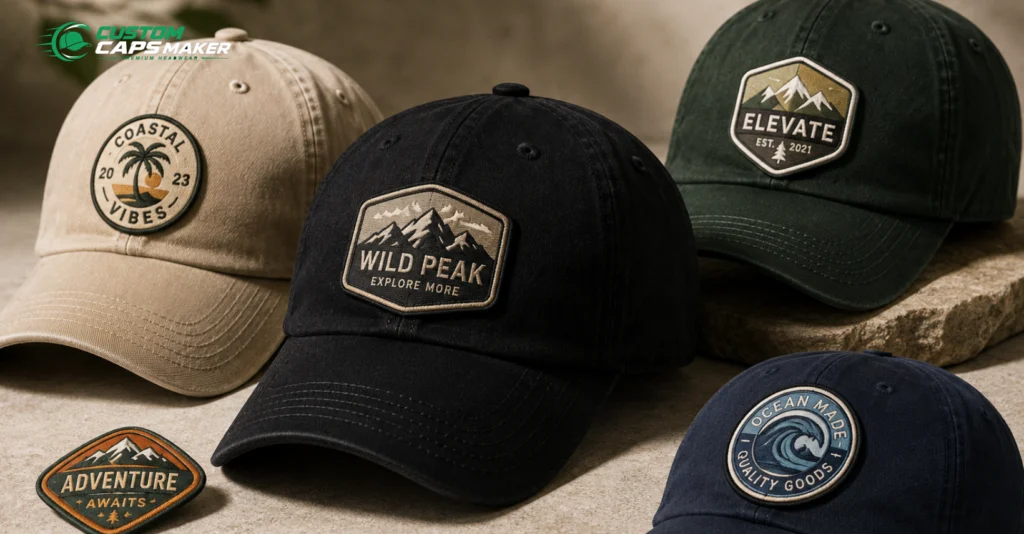
Custom caps have become much more than simple accessories. Today, businesses, fashion labels, sports teams, clubs, creators, outdoor brands, and individuals use caps to communicate identity, promote a logo, and create a recognizable look. While direct embroidery remains a popular decoration method, iron-on patch caps offer another versatile way to turn ordinary headwear into something distinctive.
Iron-on patches combine the visual impact of a professionally made patch with the convenience of heat application. Instead of stitching a design directly into the cap, the artwork is produced separately and then attached to the front, side, or other suitable area of the hat. The result can have a textured, dimensional appearance while giving brands more freedom over shapes, materials, and artwork.
At Custom Caps Maker, we understand that a custom cap needs to look good before it can become effective branded merchandise. The patch needs to complement the cap profile, the artwork needs to remain clear at its actual size, and the finished product needs to feel like something customers genuinely want to wear.
This guide explores everything you need to know about iron-on patch caps, including how they work, their advantages, design considerations, suitable cap styles, application, care, and how to create professional custom headwear for your brand.
What Are Iron-On Patch Caps?
Iron-on patch caps are hats decorated with a patch that has a heat-activated adhesive backing. Rather than embroidering the logo directly onto the cap, the design is manufactured as a separate patch and attached using heat and pressure.
The patch can be embroidered, woven, printed, leather-style, or produced using other materials depending on the desired appearance. Heat application activates the adhesive, allowing the patch to bond with the appropriate cap fabric.
This approach creates a different visual effect from direct embroidery. With direct embroidery, the threads become part of the cap itself. With a patch, the artwork sits on top of the cap, creating an additional layer that can provide texture, contrast, and visual depth.
Patch-based decoration has become increasingly popular because modern brands are looking for headwear that feels more distinctive and less like standard promotional merchandise. Current custom-headwear discussions also show growing interest in embroidered, leather, woven, PVC, and mixed-material patches for caps.
Why Are Iron-On Patch Caps So Popular?
One of the biggest advantages of iron-on patches is flexibility.
A business might have a detailed logo that isn’t ideal for direct embroidery. A streetwear brand may want a bold patch with a distinctive border. A sports club may want a traditional badge-style emblem. An outdoor company may prefer a rugged leather-look patch.
A patch can accommodate many of these creative directions.
The patch also becomes a separate design element. This means the cap and the patch can be considered independently, allowing designers to create combinations of fabric, colour, shape, texture, and finish.
For brands, that flexibility can be especially useful when creating different collections.
For example, the same logo could be transformed into:
- A classic embroidered patch
- A woven patch with fine detail
- A leather-style patch for an outdoor collection
- A bold badge-shaped patch for streetwear
- A minimalist tonal patch for premium merchandise
- A colourful patch for promotional campaigns
The cap itself can also change while the core branding remains recognizable.
Iron-On Patches vs Direct Cap Embroidery
Both methods can produce excellent results, but they create different visual experiences.
Direct Embroidery
With direct embroidery, the logo is stitched directly into the cap. This gives a traditional and integrated appearance. It is particularly effective for simple logos, initials, lettering, and bold graphics.
Direct embroidery is often an excellent choice when you want the decoration to feel like part of the original cap.
Iron-On Patch
With an iron-on patch, the artwork is produced separately and attached to the cap. This creates a layered appearance and can provide more freedom regarding patch shape, border, material, and construction.
Patches can also make it easier to maintain a consistent emblem across multiple products because the same patch design can potentially be applied to different compatible headwear styles.
Modern custom-hat guides commonly identify patches as an alternative to direct embroidery, with heat application, stitching, and other attachment methods used depending on the construction.
Which One Is Better?
There isn’t one universal answer.
Choose direct embroidery when you want:
- A traditional embroidered appearance
- A clean integrated logo
- Bold lettering
- Minimal graphics
- A classic corporate or sports look
Consider an iron-on patch when you want:
- A separate badge-like design
- A stronger dimensional appearance
- More freedom with patch shapes
- Different patch materials
- A collectible or limited-edition feel
- A design that can be adapted across multiple cap styles
The right choice depends on the artwork, cap material, brand identity, quantity, and desired finish.
Types of Patches Used on Caps
Iron-on patch caps aren’t limited to one particular patch style. The material and construction can dramatically change the personality of the finished hat.
Embroidered Iron-On Patches
Embroidered patches are one of the most recognizable options.
They use thread stitched onto a fabric base and can include borders around the artwork. They provide a tactile appearance and work particularly well with bold logos, badges, lettering, mascots, and traditional graphics.
They are especially suitable for brands that want a classic, heritage-inspired appearance.
Woven Patches
Woven patches use tightly woven threads rather than the heavier raised stitching associated with traditional embroidery.
This construction can be useful when a design contains smaller details or lettering that needs to remain relatively precise. Community discussions around patch selection also commonly distinguish woven patches from embroidered patches based on their ability to reproduce finer details.
Woven patches can create a cleaner, flatter appearance and are a strong option for modern branding.
Leather and Faux-Leather Patches
Leather-style patches are particularly popular for outdoor, lifestyle, workwear, western, and premium-inspired brands.
A simple logo pressed, engraved, embossed, or printed into a leather-style patch can create a sophisticated appearance without requiring a complicated design.
Natural-looking brown, tan, black, and dark neutral finishes work particularly well with trucker hats, canvas caps, and earth-toned headwear.
Leather patches are also part of the current custom-hat trend toward tactile and premium-looking materials.
Printed and Mixed-Material Patches
Printed patches can reproduce artwork with colours, illustrations, gradients, and visual effects that may be difficult to recreate using conventional stitching alone.
Mixed-material patches can combine different textures to create something more distinctive. Current custom-headwear trends include combinations such as embroidered elements with woven, felt, PVC, printed, or other materials.
For brands looking to create limited collections, this can be an excellent way to make a cap feel more like a fashion product than ordinary promotional merchandise.
Best Cap Styles for Iron-On Patches
The right cap style can make a major difference to the final result.
Baseball Caps
Baseball caps are one of the most versatile choices for patch decoration.
Their front panel provides a natural area for a centred patch, while their casual appearance makes them suitable for businesses, clubs, sports teams, events, fashion brands, and everyday wear.
A medium-sized patch generally works well because it provides enough space for the design without overwhelming the front panel.
Trucker Caps
Trucker caps are particularly effective with patches because their structured front panels can provide a strong foundation for a badge-style design.
Vintage logos, outdoor graphics, company names, bold typography, and leather-style patches can all work especially well on trucker caps.
A rugged patch combined with a contrasting mesh back can create a classic outdoor or workwear aesthetic.
Snapback Caps
Snapbacks are popular in streetwear and casual fashion.
Their structured construction can provide a strong platform for larger, bolder patches. If your brand has a large graphic or statement logo, a snapback can give it the visual space it needs.
Dad Caps
Dad caps have a relaxed and understated appearance.
Instead of using a large patch, consider a smaller minimalist badge, logo, or woven patch. A subtle patch can complement the relaxed shape without making the cap feel overly structured.
5-Panel Caps
Five-panel caps can be excellent for modern streetwear, outdoor brands, creative businesses, and lifestyle labels.
Because the front panel has a distinctive construction, patch placement needs to be carefully considered. A clean, appropriately sized patch can create a very contemporary appearance.
How to Choose the Right Patch Size
Patch size is one of the most important decisions when creating an iron-on patch cap.
A patch that is too small may disappear visually. A patch that is too large can overwhelm the cap and interfere with its proportions.
For many cap designs, a patch around 2 to 3 inches can provide a practical balance between visibility and proportion, although the ideal size depends on the cap profile and artwork. Current custom patch guidance also identifies the 2–3 inch range as a common choice for modern cap designs.
However, don’t choose a size simply because it is popular.
Instead, consider:
- The width of the front panel
- The height of the design
- The amount of text
- The shape of the patch
- The cap profile
- Whether the design is horizontal or vertical
- How much empty space surrounds the logo
At Custom Caps Maker, we recommend considering the complete cap and patch combination rather than designing the patch in isolation.
Keep Your Artwork Clear
One of the most common mistakes in custom patch design is trying to include too much information.
A cap is viewed from a distance. Your logo may look perfectly clear on a computer screen but become difficult to read once reduced to a small patch.
Avoid unnecessarily tiny:
- Text
- Taglines
- Thin lines
- Intricate borders
- Small symbols
- Complex illustrations
Instead, simplify where possible.
A strong patch often uses one central idea. A bold symbol, memorable wordmark, initials, mascot, or simple badge can be much more effective than trying to reproduce an entire brand identity system on a small patch.
Shape Matters
A patch doesn’t have to be a rectangle.
Custom shapes can help reinforce your brand personality.
Popular options include:
- Circles
- Ovals
- Shields
- Squares
- Arches
- Hexagons
- Custom die-cut silhouettes
- Badge shapes
- Mascot outlines
A custom shape can make the patch feel purpose-built rather than generic.
For example, an outdoor brand might use a mountain-shaped patch. A motorcycle-inspired label could use a shield. A sports club could use a crest.
Current patch trends also show increasing interest in custom and die-cut shapes rather than relying exclusively on standard geometric formats.
Choosing Colours for an Iron-On Patch Cap
Colour is another major part of the design.
The patch should have enough contrast against the cap to remain visible, but contrast doesn’t always mean using bright colours.
A premium brand might use:
Black cap + dark grey patch
for a subtle tonal look.
A lifestyle brand could choose:
Olive cap + tan patch
for an outdoor aesthetic.
A streetwear brand might use:
Black cap + cream patch + red accent
for a stronger visual statement.
The important thing is hierarchy. Decide what viewers should notice first.
If your logo is the primary focus, the patch should support it rather than compete with it.
Why Minimalist Iron-On Patches Work So Well
Modern branding increasingly values simplicity.
A clean patch with a small number of colours can look premium and remain recognizable even when viewed from a distance.
Minimalist designs also give brands more versatility.
A simple logo can work on:
- Baseball caps
- Trucker caps
- Snapbacks
- Beanies
- Jackets
- Bags
- Workwear
- Promotional products
This makes a well-designed patch more than a decoration. It can become a reusable branding asset.
Iron-On Patch Caps for Businesses
Businesses can use custom patch caps as practical promotional merchandise.
Instead of giving customers a cap that looks like traditional advertising, brands can create something people genuinely want to wear.
This is especially valuable when the design feels like merchandise rather than a uniform.
Potential uses include:
Company Merchandise
Create caps featuring your logo for employees, customers, events, or promotional campaigns.
Retail Brands
Fashion and lifestyle brands can use patches to create seasonal or limited-edition collections.
Restaurants and Cafés
A badge-style logo can transform a simple cap into branded merchandise.
Outdoor Companies
Leather-style and embroidered patches can complement hiking, camping, fishing, and adventure-focused identities.
Sports Teams
Crests, mascots, team names, and initials can be transformed into wearable patches.
Clubs and Communities
Custom patches can create a shared visual identity among members.
Events
Concerts, festivals, conferences, competitions, and charity events can all use custom patch caps as merchandise.
Iron-On Patch Caps for Fashion Brands
For fashion brands, the cap needs to feel intentional.
The patch should complement the clothing collection rather than simply display the company name.
One effective approach is to develop a visual patch system.
For example:
Collection One: Minimal logo patch
Collection Two: Oversized graphic patch
Collection Three: Vintage embroidered badge
Collection Four: Leather-style heritage patch
This creates consistency while allowing each collection to feel different.
Patch decoration is particularly useful for brands experimenting with limited drops and collaborations because different patch designs can create distinct editions without changing the entire cap concept.
Iron-On Patches and Streetwear
Streetwear is built around identity, graphics, texture, and limited releases, making patch caps a natural fit.
A bold embroidered patch can become the main visual element of a cap.
You can experiment with:
- Oversized graphics
- Distressed embroidery
- Vintage badge shapes
- Contrast borders
- Mixed materials
- Tonal designs
- Retro colour palettes
- 3D or raised elements
Current 2026 patch trends are also moving toward texture, minimalist designs, custom shapes, and mixed-material construction.
The key is not to use every trend at once.
Choose the elements that make sense for your brand.
How Are Iron-On Patches Applied to Caps?
Professional application generally involves positioning the patch correctly and applying controlled heat and pressure so the adhesive bonds with the compatible cap material.
The exact application process depends on:
- Patch backing
- Adhesive type
- Cap fabric
- Cap construction
- Heat requirements
- Pressure
- Application equipment
This is why it is important not to assume every iron-on patch can be applied identically.
Heat-sensitive materials may require different treatment, and certain cap fabrics may not be suitable for a particular adhesive backing.
For commercial production, following the manufacturer’s recommended application conditions is important for achieving a secure and consistent result.
Can Iron-On Patch Caps Be Washed?
Yes, but care matters.
The patch itself may be durable, but repeated washing, excessive heat, aggressive detergents, and poor application can affect the overall product.
For best results:
- Follow the cap manufacturer’s care instructions.
- Avoid unnecessary high heat.
- Prefer gentle cleaning methods where appropriate.
- Do not aggressively scrub the patch.
- Allow the cap to dry naturally when suitable.
- Avoid repeatedly exposing adhesive-backed patches to excessive heat.
The durability of an iron-on patch depends on the patch construction, adhesive, application quality, cap material, and how the finished hat is treated.
For demanding applications, it can also be worth discussing whether additional stitching is appropriate for the intended use.
Common Mistakes to Avoid
1. Making the Patch Too Large
A large patch isn’t automatically better.
If it takes up almost the entire front panel, the cap can look crowded.
2. Using Tiny Text
Small text is one of the biggest causes of poor readability.
Simplify your design before production rather than trying to force every detail into the patch.
3. Ignoring the Cap Shape
A patch that looks perfect in a flat digital mockup may look different once placed on a curved crown.
Always consider how the design will appear on the actual cap.
4. Choosing Poor Colour Contrast
If the patch and cap are too similar in colour, the logo can disappear.
5. Using the Wrong Patch Style
A rugged leather-style patch might not suit a luxury minimalist brand. Similarly, a brightly coloured embroidered badge might not fit a premium corporate identity.
The patch should reflect the personality of the brand.
6. Skipping a Sample
If you’re ordering a large quantity, a sample or digital mockup can help you evaluate proportions before committing to production.
7. Treating Every Cap Fabric the Same
Different materials respond differently to heat and pressure. Application should always be matched to the cap and patch construction.
How to Create a Professional Iron-On Patch Cap
A strong result usually comes from a simple process.
Step 1: Define the Purpose
Decide why you’re making the caps.
Are they for:
- Branding?
- Retail?
- Uniforms?
- Events?
- Sports?
- Streetwear?
- Promotional giveaways?
- A limited-edition collection?
Your purpose will influence the design.
Step 2: Choose the Cap
Select the right profile, fabric, colour, and construction.
Step 3: Prepare the Artwork
Simplify your logo where necessary and make sure important elements remain visible at the final size.
Step 4: Select the Patch Type
Choose embroidered, woven, leather-style, printed, PVC, or another suitable construction based on your desired appearance.
Step 5: Select the Shape and Size
Make sure the patch fits the front panel naturally.
Step 6: Create a Mockup
A realistic mockup can help you identify proportion, colour, and placement issues before production.
Step 7: Review the Sample
If possible, inspect a physical sample before placing a larger order.
Step 8: Move Into Production
Once the design, cap, patch, size, and application method are approved, the final production can begin.
Why Quality Matters More Than You Think
A cap is something people hold, wear, adjust, store, wash, and carry around.
That means quality is visible from multiple angles.
A poorly finished patch can make an otherwise premium cap look inexpensive.
Look for:
- Clean patch edges
- Consistent stitching
- Sharp artwork
- Suitable backing
- Accurate colours
- Proper positioning
- Reliable application
- A cap that complements the patch
At Custom Caps Maker, our focus is on creating custom headwear that looks like a finished product rather than generic promotional merchandise.
The goal isn’t simply to attach a logo to a cap.
The goal is to create a cap people actually want to wear.
Are Iron-On Patch Caps Good for Small Businesses?
Absolutely.
Small businesses often need promotional products that balance branding with everyday usability.
A cap with a professionally designed patch can function as both merchandise and advertising.
When someone wears your cap in public, your brand travels with them. Unlike an advertisement that disappears when the customer closes a browser or leaves a website, wearable branding can create repeated exposure in everyday environments.
The important distinction is design quality.
Customers are more likely to wear a branded cap when it looks stylish, comfortable, and intentional.
That is why the design should focus on creating something people want first and advertising something second.
Iron-On Patch Caps for Limited Editions
Limited-edition products are another excellent application.
Imagine launching a new collection with three different patch designs:
Edition 01: Classic embroidered badge
Edition 02: Minimal woven logo
Edition 03: Premium leather-style emblem
The same cap style can become three distinct products.
This can create a collectible feeling and give customers a reason to purchase multiple versions.
Limited patches can also be used for anniversaries, collaborations, seasonal collections, special events, or milestone campaigns.
The Future of Patch-Based Custom Headwear
Custom headwear continues to move toward more tactile and visually distinctive decoration.
Instead of treating a cap as a blank surface for a logo, designers are increasingly using patches as part of the overall product design.
Current trends include:
- Minimalist patch artwork
- Tonal branding
- Custom shapes
- Leather-style patches
- Mixed materials
- Raised textures
- Vintage-inspired designs
- Bold retro colour combinations
- Sustainable material considerations
Industry trend reports for 2026 similarly highlight texture, custom shapes, mixed materials, and understated branding as important directions in patch and custom-headwear design.
This doesn’t mean every brand should follow every trend.
The strongest custom caps are usually the ones that combine current design ideas with a clear brand identity.
Frequently Asked Questions About Iron-On Patch Caps
What are iron-on patch caps?
Iron-on patch caps are hats decorated with a heat-activated patch that is bonded to a compatible area of the cap using heat and pressure.
Are iron-on patches better than embroidery?
Neither is universally better. Direct embroidery creates an integrated stitched appearance, while iron-on patches provide a separate, dimensional badge-like design. The best option depends on your artwork and branding goals.
Can I put an iron-on patch on a baseball cap?
Yes, provided the patch backing and adhesive are suitable for the cap’s material and construction.
What size patch is best for a cap?
A medium patch, often around 2–3 inches, can work well for many cap designs, but the ideal size depends on the cap profile and artwork.
Can I use detailed artwork?
Yes, although very small details should be reviewed carefully. Woven, printed, or other patch constructions may be more suitable than traditional embroidery for certain detailed designs.
Are embroidered patches available with iron-on backing?
Yes. Embroidered patches can be manufactured with heat-activated backing for suitable applications.
Can patches be placed on the side of a cap?
Depending on the cap construction and patch size, side placement can create an interesting alternative to the traditional centred front logo.
Are iron-on patch caps suitable for businesses?
Yes. They can be used for company merchandise, promotional campaigns, uniforms, events, retail products, and branded giveaways.
Can I create a custom patch shape?
In many cases, yes. Custom shapes can make the patch more distinctive and can be designed around the artwork.
Should I order a sample first?
For a new design or larger production run, a sample is a sensible way to check the cap, patch size, colours, placement, and overall appearance before committing to a larger quantity.
Final Thoughts
Iron-on patch caps offer an excellent combination of creativity, versatility, and visual impact. They allow brands to move beyond conventional direct embroidery and create headwear with a distinctive layered appearance.
From embroidered badges and woven logos to leather-style patches and modern mixed-material designs, there are numerous ways to develop a cap that reflects your identity.
The most important thing is to think about the complete product.
Choose a cap that fits your audience. Select a patch style that matches your brand. Keep the artwork clear. Choose an appropriate size. Pay attention to colour contrast and placement. Most importantly, make sure the finished cap looks like something your customers would genuinely enjoy wearing.
At Custom Caps Maker, we believe custom headwear should combine branding with style. Whether you’re developing merchandise for a growing business, launching a streetwear collection, outfitting a team, promoting an event, or simply creating your own unique caps, a well-designed iron-on patch can turn an ordinary hat into a memorable piece of headwear.
Your logo deserves more than simply being placed on a cap.
Turn it into a patch. Turn the patch into a statement. Turn the statement into a cap people want to wear.