
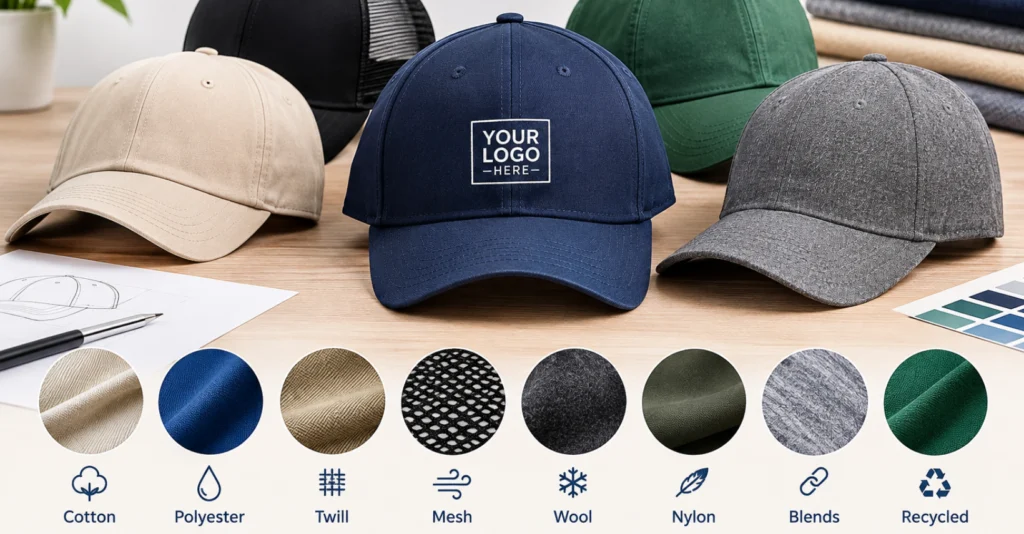
When you are ordering custom baseball caps, the design is usually the first thing you think about. You choose your logo, colours, embroidery, patch, closure and cap style. But there is another decision that can have an even bigger impact on the finished product: the material used to make the cap.
The fabric affects how the cap feels, how long it lasts, how well it holds its shape and how your logo looks after embroidery or printing. It can also determine whether the cap is comfortable enough for all-day wear during a sports event, outdoor activity, workday or promotional campaign.
For UK businesses, sports clubs, clothing brands, events and organisations, choosing the right material is particularly important. A lightweight cap that works well during a summer festival may not be the same choice you want for a winter workwear collection. Likewise, a premium fashion brand may want a completely different fabric from a football team ordering hundreds of practical team caps.
At Custom Caps Maker UK, we understand that there is no single material that works perfectly for every custom baseball cap. The right choice depends on how your caps will be used, the appearance you want, your budget and the type of customisation you need.
This guide explains the most popular materials used for custom baseball caps, their advantages and disadvantages, and how to choose the right option for your project.
Why Does the Material of a Custom Baseball Cap Matter?
A baseball cap may look like a simple product, but several different materials can be involved in its construction.
The main crown fabric is only one part of the cap. The finished product can also include:
- A stiffening layer inside the front panels
- A material or insert inside the peak
- A sweatband
- An adjustable closure
- Embroidery thread
- Mesh panels
- Eyelets
- Labels and other finishing components
Each part contributes to the final appearance and performance of the cap.
For example, two caps might have the same colour and identical embroidered logos but feel completely different when worn. One could be made from lightweight cotton and feel soft and breathable, while another could use a performance polyester fabric designed for sports.
Material also affects embroidery.
A stable, tightly woven fabric generally provides a good foundation for embroidered logos because the material can support the stitches. Softer or stretchier fabrics may require different embroidery settings and stabilisation to achieve a clean result.
That is why choosing the fabric should be part of the design process rather than an afterthought.
1. Cotton: A Classic Choice for Custom Baseball Caps
Cotton remains one of the most popular materials for baseball caps.
It is comfortable, versatile and suitable for a wide variety of designs. Cotton caps can work particularly well for businesses, casual fashion brands, clubs, schools, promotional campaigns and everyday branded headwear.
One of the biggest advantages of cotton is its natural feel. The fabric is comfortable against the skin and can become softer with use.
Cotton also offers a classic appearance that works with almost any branding style.
Advantages of Cotton Caps
Cotton is popular because it offers a good combination of:
- Comfort
- Breathability
- Natural feel
- Versatility
- Easy customisation
- Classic appearance
- Suitable everyday wear
Cotton is particularly useful when your priority is creating a traditional baseball cap rather than a highly technical sports product.
Cotton and Embroidery
Cotton can provide a strong surface for embroidered logos. This makes it a popular choice for companies that want a professional embroidered cap.
For example, a business could use a structured cotton baseball cap with its logo embroidered on the front. The result can look professional without making the cap feel overly formal.
Cotton can also work well with smaller branding details on the side or rear of the cap.
When Should You Choose Cotton?
Consider cotton if you are ordering caps for:
- Company uniforms
- Promotional merchandise
- Casual clothing brands
- Sports clubs
- Schools and organisations
- Events
- Everyday retail caps
- Branded giveaways
For many projects, cotton is a sensible starting point because it provides a familiar balance between comfort, appearance and cost.
2. Cotton Twill: One of the Most Popular Cap Fabrics
Cotton twill deserves special attention because it is widely associated with structured headwear.
Twill is created using a distinctive diagonal weave. This construction gives the fabric a little more structure and visual texture than a simple plain weave.
That structure can be particularly useful when producing custom baseball caps.
A well-made cotton twill cap can feel substantial without becoming unnecessarily heavy.
Why Is Cotton Twill Popular?
The material provides a combination of durability, structure and comfort that works well for branded headwear.
It can also create a relatively stable base for embroidery.
If your primary objective is to produce a traditional embroidered baseball cap with a clear front logo, cotton twill is an option worth considering.
Cotton Twill for Corporate Caps
Corporate customers often want something that looks professional but is still comfortable enough to wear casually.
Cotton twill can fit this requirement well.
A company logo embroidered onto the front of a dark cotton twill cap can create a clean branded appearance without looking overly promotional.
This makes the material suitable for company uniforms, trade shows, staff clothing and branded merchandise.
3. Polyester: A Practical Material for Sports and Outdoor Caps
Polyester is another important material used in modern baseball caps.
Unlike cotton, polyester is a synthetic fibre. It is commonly selected for applications where durability, quick drying and resistance to everyday wear are important.
This makes polyester particularly relevant to sports and outdoor applications.
If your caps are going to be worn while running, training, playing sport or spending extended periods outside, polyester may be worth considering.
Benefits of Polyester
Polyester can offer:
- Good durability
- Quick drying
- Good shape retention
- Strong colour performance
- Lightweight construction
- Suitability for performance headwear
The exact performance depends on the fabric construction and cap design, so it is always worth discussing your intended use with your cap supplier.
Polyester for Sports Teams
Imagine ordering caps for a running club.
The caps may be exposed to sweat, rain and frequent washing. They may also be worn during training sessions rather than simply being used as promotional merchandise.
A performance-oriented polyester cap can make more sense in this situation than a heavier lifestyle fabric.
For football clubs, running groups, cycling teams, golf events and outdoor competitions, material selection should be based on how actively the cap will be worn.
4. Poly-Cotton Blends: Combining Two Useful Properties
You do not always have to choose between cotton and polyester.
A blended fabric combines two or more fibres to achieve a different balance of characteristics.
Poly-cotton caps are popular because they can combine some of the comfort associated with cotton with some of the durability and easy-care characteristics associated with polyester.
The exact percentage of each fibre can vary, so always ask your supplier for the actual composition.
Why Choose a Poly-Cotton Cap?
A blended cap may be suitable when you want:
- Comfortable everyday wear
- Better durability
- Easier maintenance
- A versatile appearance
- A practical option for bulk orders
This can be particularly useful for businesses that want one cap style that can handle both everyday wear and occasional outdoor use.
5. Polyester Mesh: The Go-To Choice for Trucker Caps
If you are looking at trucker caps, you will often see mesh panels at the back.
The purpose of mesh is simple: airflow.
Instead of having solid fabric across every panel, the rear section allows more air to circulate around the head.
This makes mesh-backed caps particularly popular for warm weather, outdoor activities and casual summer fashion.
Why Are Mesh Caps Popular?
Mesh trucker caps offer a distinctive appearance as well as practical ventilation.
They are commonly used for:
- Outdoor brands
- Festivals
- Summer events
- Workwear
- Fishing brands
- Automotive businesses
- Country and western-inspired designs
- Lifestyle brands
- Promotional campaigns
The front of the cap can provide a strong branding area while the mesh back creates a more relaxed and breathable feel.
Embroidery on Trucker Caps
The front panel of a trucker cap can often be customised with embroidery or other decoration.
Because the rear mesh is different from the front fabric, the two sections should be considered separately when planning your design.
If your logo contains fine details, very small text or complicated shapes, it is worth discussing the artwork before production.
6. Brushed Cotton: Soft and Casual
Brushed cotton has a softer surface compared with standard woven cotton.
The fabric is processed to create a slightly raised surface, producing a comfortable and relaxed feel.
This type of material can be particularly attractive for lifestyle brands, casual clothing ranges and fashion-oriented caps.
Instead of looking highly structured and uniform, brushed cotton can give a cap a more relaxed personality.
When Does Brushed Cotton Work Best?
Consider brushed cotton if your brand has a:
- Casual identity
- Lifestyle focus
- Streetwear aesthetic
- Vintage-inspired design
- Relaxed outdoor identity
It can be particularly effective when combined with low-profile or unstructured cap styles.
7. Chino Twill for a Relaxed Baseball Cap
Chino twill is another cotton-based option that can provide a softer and more casual appearance.
Compared with heavier structured fabrics, lightweight chino-style materials can create a relaxed cap that sits naturally on the head.
This can be useful for dad caps and other unstructured styles.
Chino Twill and Brand Identity
Material selection can actually communicate something about your brand.
A heavy structured cap may feel more athletic or traditional.
A lightweight chino-style cap can feel more casual and lifestyle-focused.
For example, a coffee shop, creative agency or independent fashion label might prefer a softer cap construction rather than a highly structured sports silhouette.
8. Nylon: Lightweight Material for Performance Headwear
Nylon is commonly associated with lightweight outdoor and performance products.
It can be useful when you want a cap that is light, practical and suited to active use.
Nylon-based fabrics can be used in running, cycling, hiking and outdoor headwear.
Depending on the specific construction, nylon can offer properties such as:
- Lightweight performance
- Quick drying
- Resistance to everyday wear
- Outdoor suitability
- Practical packability
If you are creating a technical cap for an outdoor brand, nylon may be worth discussing with your manufacturer.
9. Wool and Wool Blends for Premium Baseball Caps
Wool gives a baseball cap a noticeably different character.
It can create a premium, traditional and slightly more sophisticated appearance. Wool blends are often associated with higher-end headwear, heritage styling and cooler-weather collections.
A wool or wool-blend cap can work especially well for:
- Premium fashion brands
- Heritage brands
- Golf collections
- Autumn and winter ranges
- Luxury-inspired merchandise
- Traditional sports styling
The main consideration is temperature.
Wool generally feels warmer than lightweight cotton or mesh, so it may not be the first choice for a summer sports event.
For an autumn or winter collection, however, it can create a distinctive premium finish.
10. Acrylic: A Wool Alternative
Acrylic is a synthetic fibre that is sometimes used in headwear as an alternative or component of wool-style materials.
It can provide a similar visual direction while offering different manufacturing and care characteristics.
Acrylic blends may be useful for caps intended to have a warm, structured or premium appearance without relying entirely on natural wool.
As with any blended material, the exact composition matters, so ask for the fabric specification before placing a large order.
11. Recycled Polyester for More Sustainability-Focused Collections
Sustainability is increasingly important to customers and brands.
Recycled polyester is made using recycled polyester material rather than relying entirely on virgin polyester.
For businesses that want to explore recycled materials, this can be an option for custom headwear.
However, it is important to be precise about sustainability claims.
If a cap contains a combination of recycled and non-recycled materials, you should not simply describe the entire product as “recycled” without explaining the actual composition.
UK government guidance recommends that environmental claims about fashion products are clear and based on objective characteristics of the fabric.
If sustainability is an important part of your project, ask your supplier for specific information about:
- Fibre composition
- Recycled content percentage
- Certification, where applicable
- Manufacturing information
- Packaging
- Other components used in the cap
This allows you to communicate accurately with your customers.
12. Organic Cotton for Custom Caps
Organic cotton can be considered by brands that want to use a cotton-based fabric with specific sourcing requirements.
It can be especially relevant to clothing companies, ethical fashion businesses and brands building collections around sustainability.
However, “organic” should not be used simply as a marketing description without appropriate evidence.
If you are planning to promote your caps as organic, ask your supplier what certification or documentation is available for the fabric.
The same principle applies to recycled materials: make sure your marketing claims accurately reflect what is actually being used.
13. What Material Is Used Inside the Cap?
When people talk about cap materials, they often focus only on the outer fabric.
But the internal construction is just as important.
A structured baseball cap may contain an internal stiffening material behind the front panels.
This helps the crown retain its shape.
Buckram
Buckram is commonly used to add structure to certain cap designs.
A structured cap with internal reinforcement can create a stronger, more upright front panel.
This is useful when your logo is the main visual feature because a stable front can help create a consistent presentation.
Unstructured Caps
Unstructured caps generally do not use the same level of internal reinforcement.
Instead, the fabric naturally follows the shape of the wearer’s head.
This creates a softer and more relaxed appearance.
Neither construction is automatically better.
It depends on the style you want.
14. What Is the Peak of a Baseball Cap Made From?
The peak, also called the visor or brim, needs enough structure to maintain its shape.
The material inside the peak can influence whether the cap has a curved, flat or semi-structured appearance.
Different cap manufacturers may use different internal materials depending on the product.
For customers, the important point is to decide what type of cap you actually need.
Curved Peak
A curved peak gives a traditional baseball appearance.
It works particularly well for:
- Sports teams
- Outdoor businesses
- Workwear
- Classic branded caps
Flat Peak
A flat peak creates a more modern streetwear or fashion-oriented appearance.
It can work particularly well for:
- Streetwear brands
- Music merchandise
- Youth-focused brands
- Fashion collections
Pre-Curved Peak
A pre-curved peak provides a ready-to-wear shape without requiring the customer to curve it manually.
15. Choosing the Right Closure Material
The back closure is another part of the cap where materials matter.
Common options include:
Snapback
Snapback caps use an adjustable plastic closure.
They are popular because the wearer can easily change the fit.
Snapbacks are particularly common in sports, streetwear and promotional headwear.
Metal Buckle
A metal buckle can create a more premium appearance.
It can work well for fashion, lifestyle and heritage-style brands.
Fabric Strap
A fabric strap can provide a softer and more understated finish.
Hook-and-Loop Closure
Hook-and-loop closures are adjustable and practical.
They can be useful for caps intended for workwear, sports and applications where frequent adjustment is required.
The closure should be selected as part of the overall design rather than treated as an insignificant detail.
16. What Material Is Best for Embroidery?
There is no single material that is universally “best” for embroidery.
The result depends on:
- Fabric construction
- Fabric weight
- Cap structure
- Logo size
- Stitch density
- Thread type
- Artwork complexity
- Stabilisation
- Production settings
However, stable woven fabrics are often easier to work with for traditional embroidered logos.
Cotton twill is therefore a popular choice for custom embroidered baseball caps.
If your logo contains small text or intricate details, your artwork may need to be simplified for embroidery.
For example, a logo that looks perfect on a computer screen may contain details that are too small to reproduce clearly with stitches.
A professional cap manufacturer can help determine whether your artwork needs adjustment before production.
17. Choosing Materials Based on How You Will Use the Caps
Instead of asking “Which is the best cap material?”, ask:
“Which material is best for the way my caps will be used?”
That question produces a much more useful answer.
For Everyday Business Caps
Consider cotton or cotton twill.
These materials can provide a professional appearance while remaining comfortable for everyday wear.
For Sports Teams
Consider polyester, poly-cotton blends or performance-focused materials.
The cap may need to deal with sweat, movement and frequent cleaning.
For Hot Weather
Consider lightweight fabrics or mesh-backed trucker designs.
Ventilation becomes particularly important during prolonged outdoor use.
For Premium Fashion
Consider wool blends, premium cotton constructions or carefully selected speciality fabrics.
The goal is to create a distinctive hand feel and appearance.
For Streetwear
Consider structured cotton, brushed cotton, chino-style materials or other fashion-focused constructions.
The material should match the silhouette and branding style.
For Outdoor Work
Consider durable polyester, poly-cotton or technical materials depending on the environment.
The exact choice should take into account exposure to rain, sunlight, dirt and repeated use.
18. Custom Cap Material Comparison
| Material | Comfort | Durability | Best Use | Typical Style |
|---|---|---|---|---|
| Cotton | High | Good | Everyday wear | Classic |
| Cotton Twill | High | Good | Embroidery and branding | Structured |
| Polyester | Moderate to High | Very Good | Sports and outdoor use | Performance |
| Poly-Cotton | High | Very Good | Workwear and everyday use | Versatile |
| Mesh | High in warm conditions | Good | Summer and outdoor wear | Trucker |
| Brushed Cotton | Very High | Moderate | Lifestyle and streetwear | Relaxed |
| Chino Twill | High | Moderate | Dad caps and casual styles | Soft |
| Nylon | Good | Very Good | Technical outdoor use | Performance |
| Wool Blend | High | Good | Premium and winter collections | Premium |
| Acrylic Blend | Good | Good | Warm or fashion caps | Heritage |
Remember that actual performance varies according to fabric weight, construction, finishing, cap design and manufacturing quality.
19. Does Material Affect the Price of Custom Caps?
Yes.
The cost of a custom baseball cap can depend on many factors, including:
- Fabric
- Cap construction
- Number of panels
- Closure
- Embroidery
- Printing
- Patch type
- Order quantity
- Packaging
- Additional finishing
- Delivery requirements
A basic cotton cap may be more economical for a large promotional order, while a premium wool-blend cap with specialist finishing may cost considerably more.
This does not mean you should automatically choose the cheapest fabric.
Instead, think about value.
If you are producing caps that customers will wear repeatedly, investing in a better-suited material can make more sense than choosing the lowest initial price.
20. What About UK Weather?
The UK has a famously changeable climate.
One day you may have bright sunshine, while the next brings rain and cooler temperatures.
That means material selection should depend on when and where the cap will be worn.
For summer events, mesh or lightweight fabrics can be attractive.
For everyday year-round branded caps, cotton and blended fabrics can provide versatility.
For autumn and winter collections, heavier materials and wool blends may be more appropriate.
For outdoor work, sports and active use, performance materials may offer practical advantages.
If you are ordering a large number of caps for a UK business, think about the season in which they will actually be used.
21. How to Choose the Right Material for Your Custom Caps
Before placing your order, ask yourself these questions:
1. Who will wear the caps?
Are they employees, customers, athletes, students or fashion consumers?
2. Where will they wear them?
Will they be worn indoors, outdoors, on the sports field, at festivals or during work?
3. How often will they be used?
Occasional promotional merchandise has different requirements from everyday workwear.
4. What season are you targeting?
A summer collection and winter collection may need different materials.
5. How will the logo be applied?
Embroidery, printing, woven patches and other decoration methods can work differently with different fabrics.
6. What appearance do you want?
Do you want structured and professional, relaxed and casual, sporty, premium or fashion-focused?
7. What is your budget?
Material is only one part of the total cost, so consider the complete specification.
8. How many caps are you ordering?
Bulk orders may give you access to more material and customisation options.
22. UK Textile Labelling: What Buyers Should Know
If you are selling textile products in the UK, fibre composition and labelling are important considerations.
UK government guidance states that textile products generally need information showing their fibre content, and products containing different fibre compositions may require the composition of those components to be identified.
This matters particularly if you are buying custom caps to resell under your own brand.
Before selling a product, confirm the applicable current UK requirements for your specific product, especially if you are importing, manufacturing or placing branded textile products on the market.
Do not assume that a supplier’s product description automatically provides everything you need for your own compliance responsibilities.
23. Should You Choose One Material for Your Entire Collection?
Not necessarily.
If you are developing a cap collection, using several materials can actually make the range more interesting.
For example, a clothing brand could offer:
Everyday Range:
Cotton twill baseball caps.
Summer Range:
Mesh-backed trucker caps.
Performance Range:
Lightweight polyester or nylon caps.
Premium Range:
Wool-blend caps with premium closures.
This gives customers different choices while keeping your branding consistent.
24. Why Customisation Should Be Considered Before Choosing the Fabric
Your logo and decoration method should influence your material decision.
Suppose your logo contains:
- Large lettering
- Small text
- Fine lines
- Multiple colours
- A detailed illustration
- A simple icon
Each design may behave differently when embroidered.
A simple bold logo can often translate effectively to a wide range of cap materials.
A highly detailed logo may require adjustments to size, stitch density or artwork.
This is why it is useful to provide your artwork to your custom cap supplier before finalising the material.
At Custom Caps Maker UK, your cap design can be considered alongside the material, style and customisation requirements rather than treating each element separately.
25. Common Mistakes When Choosing Cap Materials
Choosing Based Only on Appearance
A cap can look fantastic in a product photograph but may not be suitable for the intended use.
Always think about comfort and durability as well.
Choosing the Cheapest Material
Lower cost can be useful for large promotional orders, but the cheapest option is not always the best value.
If the caps need to survive frequent use, investing in an appropriate fabric can be worthwhile.
Ignoring the Season
A heavy cap may not be comfortable at a summer outdoor event.
Likewise, a lightweight mesh cap may not fit the requirements of a winter collection.
Forgetting About the Logo
Your embroidery or printing method should be considered before choosing the final cap.
Not Asking About Composition
If you are selling caps under your own brand, make sure you know what the product is actually made from.
26. The Best Material Depends on Your Goals
There is no universal winner when it comes to baseball cap materials.
Instead, each fabric has a different purpose.
Cotton is comfortable and versatile.
Cotton twill is a dependable choice for structured branded caps.
Polyester is useful for sports and performance applications.
Poly-cotton provides a versatile blend of characteristics.
Mesh is ideal when ventilation is important.
Brushed cotton creates a softer lifestyle appearance.
Nylon is useful for lightweight technical designs.
Wool blends can create a premium, traditional feel.
Recycled and organic materials can be considered when material sourcing and sustainability are important parts of your brand strategy.
The most important thing is to match the material to the actual purpose of the cap.
27. Order Custom Baseball Caps from Custom Caps Maker UK
Choosing the right material is only the first step.
A successful custom cap also depends on the design, construction, decoration method, sizing, closure and finishing.
At Custom Caps Maker UK, we help businesses, sports teams, organisations, clothing brands and individuals create custom headwear based on their specific requirements.
Whether you are looking for embroidered baseball caps, promotional headwear, team caps, branded workwear, trucker caps or custom fashion headwear, the specification should be built around how you intend to use the finished product.
If you already have your logo or artwork, you can use it as the starting point for your cap design.
Not sure which material or style is suitable?
Share your requirements with us, including:
- Quantity
- Cap style
- Logo or artwork
- Preferred colours
- Embroidery or other customisation
- Intended use
- Target delivery date
Our team can then help you work towards a cap specification that matches your project.
Final Thoughts: Choosing the Right Custom Baseball Cap Material
The material of a baseball cap can influence almost everything about the finished product, from comfort and durability to appearance and branding quality.
For a traditional everyday cap, cotton and cotton twill remain practical choices. For sports and outdoor activities, polyester, nylon and blended performance fabrics can offer useful advantages. Mesh is particularly useful when ventilation is important, while wool blends can provide a premium look for cooler-weather and fashion collections.
The best material is therefore not necessarily the most expensive or the most technically advanced option.
It is the material that fits your customers, your brand, your budget and the way your caps will actually be worn.
Before ordering custom baseball caps, consider the fabric, construction, decoration method and intended use together. Doing so can help you create headwear that does more than display your logo it can become a product that people genuinely enjoy wearing.
For custom baseball caps made around your branding and requirements, Custom Caps Maker UK can help you turn your idea into finished branded headwear.