
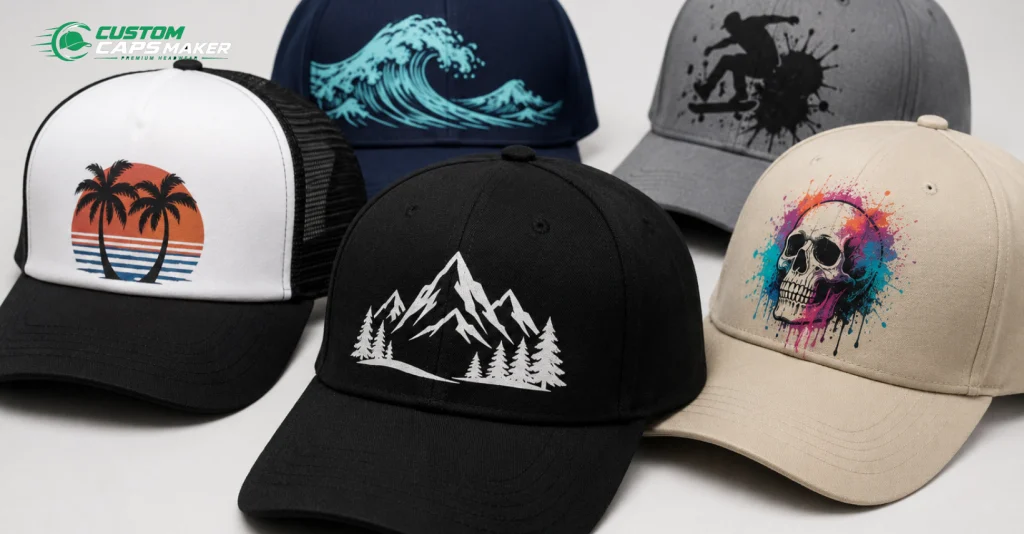
Custom caps have become much more than simple accessories. Today, they are used by businesses, clothing brands, sports teams, events, schools, clubs, charities, restaurants, gyms, influencers, and organisations of every size. A well-designed cap can promote a brand, create a sense of identity, support a marketing campaign, or become a fashionable product that customers genuinely want to wear.
When people think about custom caps, embroidery is often the first decoration method that comes to mind. Embroidered logos have been popular for decades, and they remain an excellent choice for many designs. However, embroidery is not the only way to customise headwear.
Screen print caps offer a completely different creative opportunity.
Screen printing allows designs to be applied directly to the surface of a cap using carefully prepared screens and ink. This method can create bold graphics, vibrant colours, clean shapes, detailed illustrations, and distinctive visual effects that embroidery may not always achieve as easily.
For brands that want their headwear to feel modern, creative, colourful, promotional, or fashion-focused, custom screen printed caps can be an excellent option.
At Custom Caps Maker UK, we understand that every project is different. Some customers need professional caps for their business. Others are launching a streetwear collection, organising an event, creating merchandise, or producing promotional products. The best decoration method depends on the artwork, the cap style, the placement, and the overall look you want to achieve.
This guide explores everything you need to know about screen print caps. We will cover how the process works, the advantages of screen printing, the best cap styles for printed designs, artwork considerations, placement options, comparisons with embroidery and other decoration methods, and practical tips for designing headwear that people will actually want to wear.
What Are Screen Print Caps?
Screen print caps are hats or caps that have a design applied using a screen-printing process.
The basic principle is straightforward. A design is prepared as a stencil on a fine mesh screen. Ink is then pushed through the open areas of that screen and transferred onto the cap. Depending on the design, multiple screens may be used to apply different colours.
The finished result is a printed graphic directly on the fabric or surface of the cap.
Screen printing is commonly associated with T-shirts and other flat garments, but it can also be used for headwear. Printing on caps requires additional care because caps are curved, structured differently, and often contain seams that can affect artwork placement and ink transfer. For this reason, the cap style and design need to be considered together before production begins.
A successful screen printed cap is not simply a flat graphic placed on a hat mock-up. The design must work with the actual shape and construction of the headwear.
When this is done correctly, the results can be eye-catching, stylish, and highly effective for branding.
How Does Screen Printing on Caps Work?
Although the finished product may look simple, creating high-quality screen printed caps involves several important stages.
1. Preparing the Artwork
Everything begins with the design.
The artwork needs to be reviewed to determine whether it is suitable for printing on the selected cap. Factors that may need consideration include:
- Number of colours
- Size of the design
- Line thickness
- Small text
- Fine details
- Gradients
- Halftones
- Placement
- Centre seams
- Shape of the cap
Simple, bold artwork is often easier to reproduce on curved headwear than extremely detailed designs.
Vector artwork such as AI, EPS, or SVG files is generally preferred because it can be scaled cleanly. High-resolution artwork may also work depending on the design and production requirements. Providing the intended placement and approximate size along with the artwork can help ensure that the design is prepared for the actual cap rather than just a flat digital layout.
2. Creating the Screen
A screen is prepared with the artwork so that certain areas allow ink to pass through while other areas remain blocked.
For a simple one-colour design, one screen may be required.
A multi-colour design may require separate screens for different colours.
The more complicated the artwork becomes, the more important accurate setup and registration become.
3. Positioning the Cap
Unlike a T-shirt, a cap cannot simply be laid flat on a printing surface.
The cap must be positioned securely so that the printable area is properly supported. A suitable cap platen or fixture helps keep the headwear stable during printing.
This step is particularly important because even a small movement can affect the sharpness and placement of the finished design.
4. Applying the Ink
Ink is pushed through the prepared screen and onto the cap.
The printer must use a controlled printing process to achieve even coverage and clean edges. The shape, texture, and structure of the cap can all affect the result.
Curved surfaces, seams, and different fabric types make cap printing more technically demanding than printing on a flat garment. This is why simple designs and appropriate cap construction can make a significant difference to the final appearance.
5. Curing the Print
Once the design has been printed, the ink needs to be properly cured according to the ink system and production process.
A print that looks dry is not necessarily fully cured. Proper curing is important for the durability and performance of the finished decoration.
6. Quality Checking
Before an order is completed, the finished caps should be checked for consistency.
Important quality considerations include:
- Correct design placement
- Clean edges
- Even colour coverage
- Accurate registration
- No unwanted ink marks
- Consistent appearance across the order
Quality control is especially important for branded headwear because even small placement differences can be noticeable on a cap.
Why Choose Screen Print Caps?
Screen printing offers several advantages for custom headwear.
Bold and Vibrant Designs
One of the biggest advantages of screen printing is the visual impact it can create.
Bold colours, solid shapes, illustrations, and graphic artwork can look extremely effective when printed onto the right cap style.
This makes screen printing particularly suitable for:
- Promotional graphics
- Streetwear artwork
- Event designs
- Team graphics
- Festival merchandise
- Large logos
- Slogans
- Illustrations
- Creative branding
If your design depends on colour rather than texture, screen printing may be worth considering.
Great for Graphic-Based Artwork
Embroidery is excellent for logos and premium stitched designs, but highly detailed artwork can sometimes be difficult to reproduce with thread.
Screen printing can provide an alternative for designs containing:
- Large solid areas
- Fine graphic elements
- Illustrated shapes
- Bold typography
- Flat colour artwork
- Creative patterns
The key is still to design for the actual cap rather than assuming every graphic that works on a T-shirt will work equally well on curved headwear.
A Distinctive Look
A screen printed cap has a different visual personality from an embroidered cap.
Embroidery adds texture and dimension.
Screen printing creates a flatter, more graphic appearance.
Neither method is automatically better. The right choice depends on your brand and design.
A luxury corporate logo might look best embroidered.
A colourful music festival design may look better screen printed.
A streetwear brand may even use both methods across different collections.
Suitable for Promotional Orders
Screen printing can be particularly practical for promotional projects involving bold, straightforward artwork.
Businesses may use printed caps for:
- Product launches
- Marketing campaigns
- Staff events
- Exhibitions
- Charity events
- University societies
- Sports events
- Festivals
- Brand giveaways
The design and order requirements should always be reviewed individually, but simple artwork can make screen printing a practical option for promotional headwear.
Best Cap Styles for Screen Printing
Not every cap behaves the same way during printing.
The shape, fabric, construction, seams, and structure of the crown can all affect which designs are most suitable.
Foam Trucker Caps
Foam-front trucker caps are often a strong choice for bold screen printed artwork.
The front panel can provide a smooth and visually prominent area for a graphic.
These caps work particularly well for:
- Retro designs
- Large text
- Simple illustrations
- Vintage-inspired graphics
- Event merchandise
- Promotional branding
The classic trucker cap aesthetic also works well with bold screen printed designs.
5 Panel Caps
Five-panel caps can offer a clean front area that works well for centred graphics.
They are popular for:
- Streetwear brands
- Outdoor brands
- Promotional collections
- Fashion merchandise
- Lifestyle designs
Because the design is being placed on headwear rather than a flat surface, the available print area should always be considered before finalising the artwork.
Structured Caps
Structured caps can also be screen printed, although the crown shape and seams require careful consideration.
A six-panel cap often has a centre seam running through the front of the crown. A design placed directly across that seam may not produce the same result as it would on a completely flat surface.
This does not mean structured caps cannot be printed. It simply means that artwork placement becomes more important.
Designs may need to be:
- Sized appropriately
- Positioned carefully
- Simplified
- Adjusted to avoid critical details crossing a seam
Unstructured Caps
Unstructured caps have a softer feel and can create a relaxed, casual appearance.
They can work well with smaller and simpler printed graphics.
However, softer fabric may move differently during production, so the cap needs to be supported correctly.
These styles are popular with:
- Lifestyle brands
- Coffee shops
- Independent clothing labels
- Outdoor brands
- Creative businesses
Beanies and Other Soft Headwear
Screen printing can also be considered for selected soft headwear, although stretch and texture can make fine detail more challenging.
Simple, compact artwork is generally easier to manage than highly detailed graphics.
The final decoration method should be selected based on the material and the visual effect required.
Choosing the Right Design for Screen Printed Caps
One of the most important lessons in custom headwear is this:
A great design on a computer screen does not automatically become a great design on a cap.
Caps have limited printable areas and curved surfaces. A design should therefore be created specifically with the product in mind.
Keep Important Details Clear
Very small text may become difficult to reproduce clearly on a cap.
Before finalising your artwork, consider whether the smallest details are genuinely necessary.
Ask yourself:
- Can the design still be recognised from a distance?
- Is the text readable?
- Are thin lines important to the identity of the design?
- Could the artwork be simplified without losing its character?
Simple does not mean boring.
Some of the most memorable cap designs use only one strong logo, symbol, word, or graphic.
Avoid Overcrowding the Front Panel
The front of a cap may look like a large blank canvas in a digital mock-up, but the real printable area is limited by the crown shape.
A design that is too large can begin to wrap around the curved surface or approach seams and edges.
Keeping the artwork balanced can create a cleaner and more professional result.
Consider the Centre Seam
Many traditional six-panel caps feature a seam in the centre of the front crown.
Fine lines, small text, and important visual elements may not be ideal when placed directly across this area.
Artwork can sometimes be adjusted by:
- Moving the design slightly
- Reducing the width
- Changing the layout
- Using a different cap construction
- Selecting another decoration method
Placement planning is an important part of creating successful printed headwear.
Popular Placement Options for Screen Print Caps
The front of the cap is the most common location, but it is not the only option.
Front Panel Printing
The front is ideal for:
- Main logos
- Brand names
- Event graphics
- Illustrations
- Large typography
For most businesses, the front panel provides the strongest branding opportunity.
Side Printing
Side printing can be used for smaller secondary details.
Popular options include:
- Website initials
- Small logos
- Icons
- Campaign symbols
- Dates
- Numbers
Side decoration can add personality without overwhelming the main design.
Back Printing
Back printing is often used for subtle branding.
Examples include:
- Brand names
- Website addresses
- Slogans
- Small symbols
A small back detail can make a cap feel more considered and complete.
Multi-Location Decoration
Some brands choose a combination of placements.
For example:
- Main screen printed graphic on the front
- Small brand mark on the side
- Slogan on the back
The key is to maintain balance. Too many competing elements can make the cap feel cluttered.
Screen Printing vs Embroidery on Caps
This is one of the most common questions when ordering custom headwear.
Both methods can produce excellent results.
The right choice depends on the design and desired finish.
| Feature | Screen Printing | Embroidery |
|---|---|---|
| Appearance | Flat and graphic | Textured and dimensional |
| Best for | Bold graphics and colour | Logos and premium branding |
| Detail | Suitable for many graphic details | Small details may need simplification |
| Texture | Smooth printed finish | Raised stitched finish |
| Colour style | Strong flat colours | Thread-based colours |
| Visual personality | Modern, graphic, creative | Classic, premium, traditional |
Embroidery often works particularly well for:
- Corporate logos
- Golf caps
- Uniforms
- Premium merchandise
- Sports branding
Screen printing may be more suitable for:
- Graphic artwork
- Promotional designs
- Creative fashion concepts
- Bold typography
- Event merchandise
The decision should be based on the artwork rather than automatically choosing one decoration method for every project.
Screen Printing vs Printed Patches
Another option is to create a printed patch and apply it to the cap.
This can offer different possibilities depending on the patch material and attachment method.
A patch can create a more defined decorative area and may allow artwork to be positioned differently from direct printing.
Printed patches can be useful for brands that want:
- A badge-style appearance
- A separate decorative element
- Multi-texture designs
- A distinctive merchandise look
At Custom Caps Maker UK, the best option depends on the product concept.
Sometimes direct screen printing is the strongest choice.
Sometimes embroidery is more suitable.
In other cases, a custom patch may provide the visual effect the customer wants.
Screen Printing vs DTF and Other Printing Methods
Screen printing is not the only way to create printed headwear.
Depending on the design, other methods may also be considered.
DTF Printing
DTF can be useful for colourful and complex designs.
It may suit artwork that includes:
- Multiple colours
- Fine details
- Complex illustrations
The final appearance is different from traditional screen printing, so the choice should be based on the desired finish and production requirements.
Heat Transfer
Heat transfers can also be used for selected designs.
They may be appropriate for specific artwork and order types.
Sublimation
Sublimation is generally associated with suitable polyester materials and can produce vibrant all-over or integrated designs on compatible products.
Every printing method has strengths and limitations.
The goal is not simply to choose the newest method. It is to choose the method that works best for your design, cap material, and intended use.
Are Screen Print Caps Durable?
A properly produced screen printed design can provide a durable decoration when the artwork, ink, cap material, and curing process are suitable for one another.
Durability can be affected by:
- Quality of the ink
- Proper curing
- Fabric type
- Frequency of use
- Washing method
- Exposure to heat
- General wear
To help maintain printed headwear, customers should follow the care instructions provided for the specific cap and decoration.
General care may include:
- Avoiding excessive heat
- Avoiding direct ironing on the printed design
- Using gentle cleaning methods when appropriate
- Allowing the cap to retain its shape while drying
- Avoiding unnecessarily harsh abrasion
Different cap materials and structures may require different care.
Who Can Benefit from Custom Screen Print Caps?
Screen printed caps are suitable for a wide range of customers.
Clothing Brands
Fashion and streetwear brands can use screen printing to create distinctive graphic headwear.
Ideas include:
- Limited-edition collections
- Artist collaborations
- Seasonal graphics
- Vintage designs
- Bold slogans
- Illustrated artwork
Businesses
Companies can use custom caps as part of their branding.
Screen printed caps may be used for:
- Staff uniforms
- Marketing campaigns
- Customer giveaways
- Trade shows
- Brand events
Sports Teams
Teams and sports groups may use printed caps for:
- Supporters
- Training events
- Team merchandise
- Tournaments
- Fundraising
Schools and Universities
Educational organisations may create caps for:
- Societies
- Graduation events
- Sports clubs
- Freshers’ events
- Fundraising campaigns
Events and Festivals
Custom caps are useful event merchandise because they are practical, visible, and reusable.
A well-designed cap can continue promoting the event long after the day has finished.
Restaurants and Hospitality Businesses
Cafés, restaurants, food brands, and hospitality companies can use branded caps for staff or merchandise.
A simple printed logo can create a casual and modern uniform look.
How to Design Screen Print Caps That People Want to Wear
The best promotional cap does not feel like an advertisement.
It feels like a product.
This is an important difference.
If you want customers, employees, or supporters to wear your cap regularly, think beyond simply making the logo as large as possible.
Use a Strong Colour Combination
Choose cap and ink colours that create enough contrast.
For example:
- Light ink on a dark cap
- Dark graphics on a light cap
- Bold colour combinations for fashion collections
- Neutral tones for premium branding
Your brand colours should still be considered, but wearability matters too.
Create a Clear Focal Point
The design should have one main visual element.
This could be:
- A logo
- A symbol
- A word
- An illustration
Too many competing elements can make the cap look busy.
Consider the Target Audience
A cap designed for a corporate event may look completely different from one designed for a streetwear collection.
Think about:
- Who will wear it?
- Where will they wear it?
- What clothing will they pair it with?
- Do you want the branding to be subtle or bold?
These questions can help determine the correct design direction.
Create Merchandise, Not Just Advertising
A cap is more likely to be worn repeatedly if the design feels fashionable.
Consider creating a secondary graphic rather than simply placing your full company logo across the front.
For example, a coffee brand might use:
- An illustrated coffee bean
- A short phrase
- A simple icon
- A recognisable pattern
The company name could then appear more subtly on the side or back.
This approach can create merchandise that promotes the brand without looking like traditional promotional clothing.
Common Mistakes to Avoid with Screen Printed Caps
Trying to Print a T-Shirt Design Directly onto a Cap
Caps are different from flat garments.
Artwork should be adjusted for the actual headwear.
Using Too Much Fine Detail
Tiny text and extremely thin elements may not be ideal for every cap and printing setup.
Simplifying the design can often improve the finished result.
Ignoring the Cap Construction
The location of seams and the structure of the crown can affect the printable area.
Always consider the specific cap style before finalising artwork.
Choosing the Wrong Decoration Method
Screen printing is excellent for many projects, but it is not automatically the best choice for every design.
Sometimes embroidery or a patch may produce a stronger result.
Forgetting About Wearability
A promotional cap can still be stylish.
Consider whether someone would genuinely choose to wear the finished product.
Ordering Custom Screen Print Caps for Your Brand
When planning a custom cap project, preparing a few key details can make the process easier.
Try to have the following information ready:
Your Artwork
Preferred files may include:
- AI
- EPS
- SVG
- High-resolution PNG
Your Cap Style
For example:
- Baseball cap
- Trucker cap
- 5-panel cap
- 6-panel cap
- Dad cap
- Snapback
- Beanie
Your Preferred Colours
Provide the cap colour and artwork colours.
If accurate brand colour matching is important, include relevant colour references where available.
Your Placement
Tell the manufacturer where you would like the design.
Examples include:
- Front
- Left side
- Right side
- Back
Your Quantity
The quantity can affect production planning and the most suitable decoration approach.
Your Deadline
If you need the caps for an event, launch, exhibition, or campaign, it is helpful to plan the project with enough time for artwork review, production, and delivery.
Why Work With Custom Caps Maker UK?
Choosing the right custom cap is about more than adding a logo to a blank hat.
The finished product should represent your brand properly.
At Custom Caps Maker UK, we believe every project should begin with the design concept and intended use of the product.
Whether you are looking for:
- Screen print caps
- Custom embroidered caps
- Branded trucker caps
- Promotional headwear
- Custom baseball caps
- Fashion merchandise
- Event caps
- Business uniforms
the goal should be to create headwear that looks professional and feels suitable for your audience.
A bold graphic may work perfectly with screen printing.
A premium logo may look better embroidered.
A complex design may need a different approach altogether.
The most important step is choosing the combination of cap style, material, artwork, placement, and decoration method that best supports your idea.
You can explore custom headwear options through Custom Caps Maker UK.
Final Thoughts
Screen print caps offer an exciting way to create custom headwear with bold graphics, strong colours, and a distinctive visual identity.
They can be used for fashion brands, businesses, events, teams, promotional campaigns, and creative merchandise. However, successful cap printing requires more than simply uploading a design.
The artwork needs to work with the cap.
The placement needs to work with the shape.
The decoration method needs to work with the intended finish.
When these elements come together, a custom screen printed cap can become more than a promotional product. It can become part of a brand’s identity.
Whether you are launching a new clothing collection, preparing merchandise for an event, creating staff uniforms, or searching for a fresh alternative to traditional embroidered headwear, screen printing can provide a bold and creative solution.
At Custom Caps Maker UK, customisation is about helping you transform an idea into headwear that looks professional, feels relevant to your brand, and is designed with the final product in mind.
The right cap can promote your business.
The right design can make it memorable.
And the right decoration method can turn a simple piece of headwear into something people genuinely want to wear.