
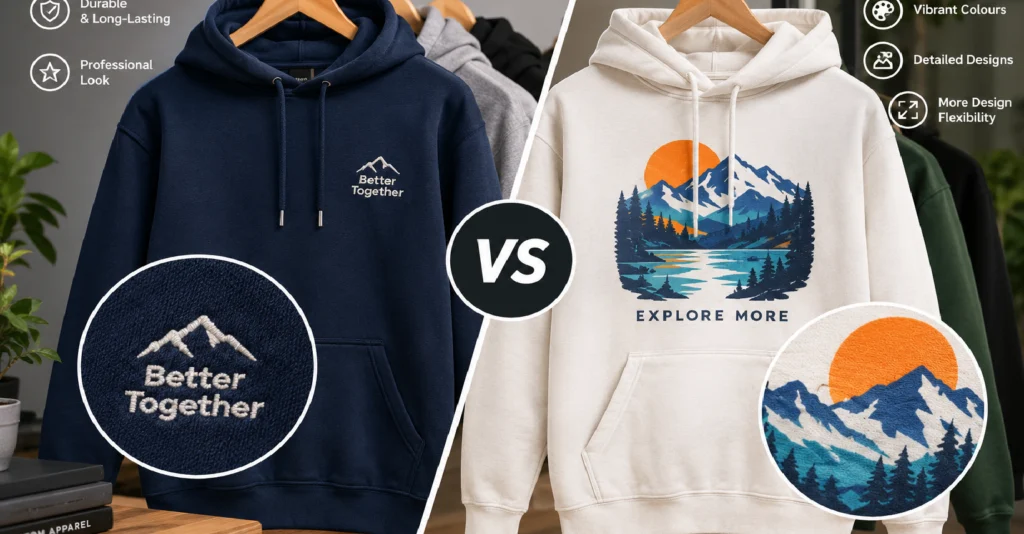
Choosing between custom embroidered hoodies and printed hoodies is an important decision for any business, clothing brand, sports team or organisation looking to create personalised apparel. Both options offer excellent ways to showcase a logo, message or creative design, but they deliver different results in terms of appearance, durability, comfort, cost and overall brand presentation.
Embroidered hoodies are known for their textured finish, professional appearance and long-lasting stitched designs. Printed hoodies, on the other hand, offer greater creative freedom, vibrant colours and the flexibility to reproduce large graphics and detailed artwork.
So, which option is right for your needs?
At Custom Caps Maker UK, personalised apparel is about more than placing a logo on a garment. The right combination of clothing, decoration method and design can help a business communicate its identity, create memorable merchandise and give customers or employees something they will want to wear.
In this guide, we compare custom embroidered hoodies vs printed hoodies to help you make an informed decision for your next order.
What Are Custom Embroidered Hoodies?
Custom embroidered hoodies feature designs created by stitching thread directly into the garment. Specialised embroidery equipment follows a digitised design file to produce logos, lettering, symbols and decorative patterns using selected thread colours.
Unlike printing, which applies a design to the surface of the fabric, embroidery creates a raised, textured finish. This gives the decoration a distinctive appearance that works particularly well for professional logos and understated branding.
Businesses often choose embroidered hoodies for staff uniforms, workwear, corporate gifts, team clothing and premium merchandise. Clothing brands also use embroidery to give their products a more distinctive finish.
Key Features of Embroidered Hoodies
1. Raised and textured designs
The stitches create a tactile surface that makes a logo feel different from the surrounding fabric. This texture can give even a relatively simple design a more substantial appearance.
2. Professional branding
Small chest logos, initials and carefully designed symbols can look neat and sophisticated when embroidered. This makes the technique suitable for businesses that want consistent branding across their clothing.
3. Strong everyday performance
Quality embroidery generally holds up well to regular use because the design is made from thread rather than a printed layer. The stitching can still snag or become damaged, so garment quality and proper care remain important.
4. Distinctive finishing
Embroidery can make a plain hoodie feel more personalised. Thread colours, stitch direction, placement and design size all influence the finished appearance.
When Should You Choose Embroidered Hoodies?
Consider embroidery when your design includes a relatively simple logo, initials, a short brand name or a compact symbol. It is particularly suitable for employee clothing, hospitality uniforms, tradespeople, clubs and businesses that want a polished appearance.
For example, a small embroidered logo on the left chest of a heavyweight hoodie can create a clean, professional look without overwhelming the garment.
However, embroidery is not ideal for every design. Photographs, complex gradients and extremely fine artwork can be difficult to reproduce accurately using thread. Large stitched designs can also add weight and stiffness to the fabric.
What Are Custom Printed Hoodies?
Custom printed hoodies feature designs applied to the fabric using a printing process. Depending on the artwork, garment and production requirements, this might involve screen printing, direct-to-garment printing (DTG), direct-to-film transfers (DTF) or another suitable method.
Printing is popular because it allows businesses and clothing brands to reproduce colourful artwork, detailed illustrations, slogans and large graphics.
A printed hoodie can feature a small chest logo, a bold front design, a large back illustration or several separate design elements across the garment.
Key Features of Printed Hoodies
1. Greater design flexibility
Printing can reproduce complex artwork, gradients, illustrations and photographic images that are difficult to translate into embroidery.
2. Vibrant colours
Printed designs can accommodate a wide range of colours, making them suitable for brands with colourful identities or artwork that depends on precise visual detail.
3. Large design possibilities
A printed design can cover a substantial part of the front, back or sleeves without requiring thousands of stitches.
4. Flexible personalisation
Printed hoodies can be a practical option for event merchandise, promotional clothing, team designs and collections featuring different names, numbers or graphics.
When Should You Choose Printed Hoodies?
Printing is worth considering when your design includes several colours, fine details, illustrations, large lettering or a bold graphic.
For example, a clothing brand launching a streetwear collection might use a large printed illustration across the back of a hoodie. An embroidered version of the same design could be more expensive, heavier and less detailed.
Printing can also work well for promotional campaigns where a business needs to display a slogan, campaign artwork or event information prominently.
Remember that print quality depends on the method used, the fabric, the application process and how the garment is maintained. A professionally applied print can last well, while an unsuitable or poorly applied print may crack, fade or peel prematurely.
Custom Embroidered Hoodies vs Printed Hoodies: The Main Differences
Although both methods can produce attractive custom clothing, they are suited to different design requirements.
Here is a quick comparison of the main factors to consider.
| Feature | Embroidered Hoodies | Printed Hoodies |
|---|---|---|
| Appearance | Raised, textured and distinctive | Smooth, flat and graphic-focused |
| Best designs | Logos, initials and simple artwork | Illustrations, slogans and complex graphics |
| Colour options | Uses available embroidery thread colours | Can reproduce a broad range of colours |
| Fine detail | Some details may need simplification | Often better for intricate artwork |
| Large designs | Can become heavy and costly | Usually more practical |
| Durability | Generally excellent with proper care | Depends on printing method and application |
| Comfort | Large stitched areas may feel stiff | Large prints may affect the fabric’s feel |
| Branding style | Professional and understated | Bold, creative and expressive |
| Cost considerations | Influenced by stitch count and design complexity | Influenced by print method, coverage and quantity |
| Common uses | Workwear, uniforms and premium logos | Merchandise, events and graphic clothing |
Neither option is automatically better for every order. The most suitable choice depends on your artwork, the intended use of the hoodie, your budget and the impression you want your brand to create.
1. Appearance and Overall Style
The appearance of your hoodie is often the first thing people notice. The decoration method influences whether your design looks subtle, professional, colourful or expressive.
The Appearance of Embroidered Hoodies
Embroidery adds depth and texture to a garment. Because the design is stitched into the fabric, it has a physical presence that can make a logo stand out without requiring bright colours or a large design area.
This makes embroidery particularly effective for minimalist branding. A small logo in a contrasting thread colour can look refined on a black, navy, grey or cream hoodie.
Embroidery also suits businesses that want their clothing to look consistent and professional. Staff uniforms, branded workwear and team apparel often benefit from a clear logo that does not dominate the entire garment.
The Appearance of Printed Hoodies
Printing gives designers more freedom to experiment with size, colour and composition. A printed design can feature detailed artwork, gradients, large lettering or several visual elements arranged together.
For fashion labels, music merchandise, creative businesses and streetwear collections, this flexibility can be particularly valuable.
Printed hoodies also make it easier to create a dramatic visual effect. A large graphic across the back or a colourful design on the front can become the main feature of the garment.
Which looks better?
Choose embroidery if you prefer a textured, understated finish. Choose printing if your design depends on colour, scale or visual detail.
2. Durability and Long-Term Performance
Durability is an important consideration when ordering custom hoodies for employees, customers or everyday wear.
The right decoration method should maintain its appearance through normal use and washing.
How Durable Are Embroidered Hoodies?
Embroidery is generally a strong choice for long-term branding. Since the design is created using stitches, it does not develop the same type of surface cracking or peeling that can affect some printed decorations.
This makes embroidery suitable for garments that are worn frequently, including workwear, uniforms and branded clothing.
However, embroidery is not indestructible. Threads can snag on sharp objects, stitching can become damaged and poorly designed embroidery can cause puckering or distortion.
The fabric also matters. A heavy hoodie can often support a stitched logo more comfortably than a lightweight garment that stretches easily.
How Durable Are Printed Hoodies?
Printed hoodies can also offer good durability when the correct printing process is selected and the design is applied properly.
Screen printing, for example, can perform well on suitable garments when the ink is correctly cured. Other methods may be better suited to complex artwork or smaller production runs.
The main consideration is that printing methods behave differently. Some prints may gradually crack, fade or peel when exposed to repeated washing, excessive heat or abrasion.
To help printed designs last longer, follow the garment’s care label, wash the hoodie inside out and avoid ironing directly over the printed area.
Our recommendation: For a simple logo on clothing that will be worn and washed regularly, embroidery is often a dependable option. For detailed artwork, a high-quality print can also provide excellent long-term performance.
3. Cost of Custom Embroidered vs Printed Hoodies
Price is another important factor, particularly when ordering for a company, team, event or clothing collection.
There is no single price difference that applies to every hoodie. The final cost depends on the garment, design, quantity and production method.
What Affects the Cost of Embroidered Hoodies?
Embroidery costs are influenced by several factors:
- Stitch count: Designs requiring more stitches generally take longer to produce.
- Design dimensions: Larger embroidery designs usually require more thread and production time.
- Artwork complexity: Multiple details and dense stitching can increase production requirements.
- Garment quality: Premium or heavyweight hoodies may cost more than basic garments.
- Order quantity: Larger orders may offer better unit pricing, depending on the supplier and setup.
- Personalisation: Individual names or different designs may require additional preparation.
A simple logo on the chest is usually more straightforward to embroider than a large, densely stitched design covering the back.
What Affects the Cost of Printed Hoodies?
Printed hoodie costs depend on different considerations:
- Printing method: Screen printing, DTG and DTF have different production requirements.
- Print dimensions: Larger graphics generally require more material or printing time.
- Number of colours: Some printing processes involve additional setup for multiple colours.
- Artwork detail: Complex designs can affect preparation and production.
- Order quantity: Certain methods become more economical at higher volumes.
- Number of print locations: Printing the front, back and sleeves can increase the overall cost.
For large orders featuring the same simple design, screen printing may provide good value. For smaller quantities or detailed full-colour artwork, another printing method may be more suitable.
Which Option Is More Affordable?
Printed hoodies can be more economical for large graphics or complex, colourful designs. Embroidery may offer better value when you want a compact logo with a premium finish and strong everyday performance.
Instead of comparing decoration costs alone, consider the total value of the finished garment. A hoodie that people wear regularly can provide more long-term brand exposure than an inexpensive item that quickly loses its appeal.
4. Design Flexibility and Artwork Requirements
Before choosing between embroidery and printing, consider how your artwork will translate to the finished hoodie.
A design that looks excellent on a computer screen may need adjustments to work effectively with a particular decoration method.
Artwork for Embroidered Hoodies
Embroidery works particularly well with clear shapes, bold lettering, recognisable symbols and logos that do not rely on tiny details.
Fine lines, small text and complicated gradients may need to be simplified. Thread cannot reproduce every visual effect that is possible with digital artwork.
For the best results, consider:
- Keeping small lettering readable.
- Using clear shapes and suitable spacing.
- Choosing contrasting thread colours.
- Selecting a design size appropriate for the hoodie.
- Checking that the garment fabric can support the stitching.
A well-prepared embroidery design should remain recognisable at its intended size.
Artwork for Printed Hoodies
Printing provides greater flexibility for detailed designs. Depending on the process, it can reproduce illustrations, photographs, shading, gradients and colourful artwork.
This is particularly useful for creative brands that use detailed graphics as part of their identity.
When preparing printed artwork, consider the final print dimensions, the hoodie colour, image resolution and the printing process being used.
A design intended for a black hoodie may require different colour choices from the same design intended for a white garment.
The key difference: Embroidery works best when the artwork can be translated into stitches. Printing is often preferable when preserving fine detail and colour transitions is essential.
5. Comfort and Feel
A hoodie should be comfortable enough for regular wear. The decoration method can affect the feel of the garment, especially when the design covers a large area.
How Embroidery Feels on a Hoodie
Embroidery creates a raised surface and adds thread to the fabric. A small logo usually has a limited effect on comfort, but a large stitched design can feel heavier or stiffer.
On lightweight hoodies, dense stitching may also pull the fabric or affect how it drapes.
For this reason, smaller embroidered logos are often a sensible choice for chest, sleeve or upper-back placement.
If you are planning to embroider a large design, ask about the garment’s suitability and the proposed stitch coverage before confirming the order.
How Printing Feels on a Hoodie
Printed designs often sit flatter against the fabric, although the feel varies by printing method.
A large print can sometimes create a noticeable surface layer. Other printing processes may produce a softer finish that follows the fabric more naturally.
The amount of ink or transfer material, the size of the design and the hoodie fabric all affect the result.
If comfort is a priority, compare samples where possible rather than assuming that every printed design will feel the same.
6. Best Hoodie Decoration for Business Branding
Custom hoodies can help businesses create a consistent appearance for staff, represent their identity at events and provide useful branded merchandise.
The most appropriate decoration method depends on the company’s industry, brand personality and intended use.
Embroidered Hoodies for Professional Businesses
Embroidery is a strong option for businesses that want a smart and consistent look.
Examples include:
- Construction and trade businesses.
- Hospitality and catering teams.
- Retail staff.
- Warehousing and logistics companies.
- Offices and customer-facing teams.
- Clubs and organisations.
A clear chest logo can make staff clothing look coordinated without making the design too prominent.
For garments that are used as workwear, consider durability, garment weight, colour consistency and ease of maintenance.
Printed Hoodies for Marketing and Promotion
Printing can be more suitable when a hoodie needs to communicate a message or display a larger design.
Businesses may use printed hoodies for:
- Product launches.
- Marketing campaigns.
- Charity events.
- Conferences and exhibitions.
- Promotional giveaways.
- Customer merchandise.
- Creative team clothing.
A larger print can communicate campaign artwork or event information more visibly than a small embroidered logo.
Which Is Better for Company Hoodies?
For simple company logos and regular staff uniforms, embroidery is often a practical choice. For campaign graphics, promotional designs and detailed artwork, printing can offer more flexibility.
Some businesses use both methods across different garments to suit different requirements.
7. Embroidered vs Printed Hoodies for Clothing Brands
For fashion labels and independent clothing businesses, the choice between embroidery and printing affects the visual identity of a collection.
It can also influence production costs, the style of the garment and how customers perceive the finished product.
When Clothing Brands Should Choose Embroidery
Embroidery works well for labels that focus on understated branding, textured details and minimalist designs.
A small logo on the chest, a symbol near the cuff or a short wordmark can create a distinctive finish without covering a large area of fabric.
This approach can suit premium casualwear, minimalist streetwear and branded basics.
It is important to make sure the hoodie fabric supports the intended stitching. The design should also remain legible and comfortable at its chosen size.
When Clothing Brands Should Choose Printing
Printing is ideal for collections built around illustrations, artwork, slogans and expressive graphics.
A streetwear brand might create a large back print with a small complementary design on the front. An artist or creator might use printing to reproduce original artwork across a limited merchandise collection.
Printing also makes it easier to experiment with colour combinations and detailed visual concepts.
Should a Brand Use Both?
Yes. Embroidery and printing can complement each other when used thoughtfully.
For example, a hoodie could feature a small embroidered logo on the chest and a large printed illustration on the back. The embroidered detail provides texture, while the print delivers the main visual statement.
Using both methods can help a brand develop a more varied collection, provided the designs work together and the added production cost fits the budget.
8. Best Hoodie Decoration for Teams, Clubs and Events
Custom hoodies are popular with sports clubs, student societies, community organisations and event teams because they combine everyday usefulness with visible group identity.
However, different groups have different priorities.
Sports Teams and Clubs
Embroidery can work well for a club crest or a compact team logo. It provides a textured finish that can be suitable for staff, coaches and supporters.
Printing may be more practical for large team graphics, sponsor artwork, player names or numbers.
The best choice depends on the design and whether the hoodie is intended for regular use, training, travel or merchandise.
Schools and Universities
School and university hoodies often include crests, initials, year-group details or personalised names.
Embroidery may suit a traditional crest or small institutional logo. Printing can accommodate larger back designs, graduation messages and colourful student artwork.
Events and Promotional Campaigns
For short-term events, printing may be useful for large campaign graphics and event-specific messages.
For staff garments that will be reused at multiple events, embroidery may be worth considering because of its professional appearance and durability.
Before ordering, confirm the required quantity, garment sizes, design placement and delivery schedule.
9. Choosing the Right Hoodie Fabric
The hoodie fabric affects both comfort and decoration quality. Even a well-designed logo may not produce the intended result if the garment is unsuitable for the chosen method.
Cotton Hoodies
Cotton hoodies are popular for their familiar feel and everyday comfort. They can be suitable for several decoration methods, depending on the fabric construction and the product specifications.
For embroidery, the fabric should be stable enough to support the stitching without excessive distortion.
For printing, the suitability of the material depends on the process being used.
Cotton-Polyester Blends
Blended fabrics are common in casual and workwear hoodies. They can offer a combination of comfort, durability and shape retention.
The precise blend affects how the garment behaves during production and washing, so it is important to check the manufacturer’s guidance.
Fleece Hoodies
Fleece-lined hoodies are often chosen for colder weather and everyday warmth.
Because fleece and other textured fabrics can influence how a design sits on the surface, the decoration method and placement should be selected carefully.
A suitable embroidery backing or stabilisation approach may be needed, while printed designs require a compatible application process.
Lightweight Hoodies
Lightweight garments may be comfortable for layering, but dense embroidery can distort thin fabric.
A smaller design or a suitable printing method may be a better choice, depending on the garment and artwork.
Practical tip: Choose the hoodie first, then confirm that its fabric and construction are suitable for your intended design.
10. How to Care for Embroidered and Printed Hoodies
Proper care helps preserve both the garment and its custom decoration.
Always follow the manufacturer’s care label because fabric blends, printing processes and thread types can have different requirements.
Caring for Embroidered Hoodies
To help maintain embroidered designs:
- Turn the hoodie inside out before washing when appropriate.
- Follow the recommended washing temperature.
- Use a suitable detergent.
- Avoid excessive heat during drying.
- Do not iron directly over the embroidery.
- Store the garment in a way that avoids unnecessary snagging.
If loose threads appear, avoid pulling them. Pulling can damage the stitching or cause further unraveling.
Caring for Printed Hoodies
To help printed designs last:
- Turn the hoodie inside out before washing.
- Follow the garment’s recommended temperature.
- Avoid harsh washing conditions.
- Avoid ironing directly over the print.
- Use low heat or air-dry when suitable.
- Avoid unnecessary stretching or abrasion across the design.
The lifespan of a printed design depends partly on the printing method and how it is applied. Following the correct care instructions can help reduce premature wear.
Which Is Easier to Maintain?
Neither option is completely maintenance-free. Embroidery generally avoids the surface cracking and peeling associated with some prints, while printing may require additional care to protect the decorated surface from excessive heat and abrasion.
Both can remain attractive for a long time when they are produced well and maintained correctly.
11. Common Mistakes to Avoid When Ordering Custom Hoodies
A good result depends on more than choosing embroidery or printing. Avoiding a few common mistakes can help you get better value from your order.
Choosing a Decoration Method Before Reviewing the Artwork
Do not assume that every logo should be embroidered or every graphic should be printed.
Review the actual artwork, its dimensions and the intended placement before selecting the process.
Ignoring the Garment Quality
A decoration method cannot compensate for a hoodie that is uncomfortable, poorly constructed or unsuitable for its intended purpose.
Consider the fabric, fit, weight, stitching and overall garment quality alongside the decoration.
Making the Design Too Small
Small text and intricate details may become difficult to read, especially when converted into stitches.
Check the design at its actual finished size rather than relying only on a large screen preview.
Ordering Without Confirming Placement
The same logo can look different on the left chest, centre chest, sleeve or back.
Confirm the position and dimensions before production begins.
Comparing Prices Without Comparing Specifications
A lower quote may involve a different garment, decoration size, print method or level of personalisation.
Compare like-for-like specifications so that you understand what each quote includes.
Forgetting About Repeat Orders
If you expect to order more hoodies later, keep a record of the approved artwork, garment details, colours and placement measurements. This can make future orders easier to coordinate.
12. How to Choose Between Custom Embroidered Hoodies and Printed Hoodies
If you are still unsure, use the following checklist to narrow down your options.
Choose embroidered hoodies if:
- You want a raised, textured logo.
- Your artwork is relatively simple.
- You need branded workwear or staff uniforms.
- You prefer understated, professional branding.
- Long-term performance is a priority.
- You want a small logo rather than a large graphic.
Choose printed hoodies if:
- Your artwork contains multiple colours or gradients.
- You need a large front or back design.
- You want to reproduce illustrations or photographs.
- You are producing event or campaign merchandise.
- Your design includes detailed slogans or graphics.
- You want greater flexibility for expressive artwork.
Consider combining both if:
- Your brand uses a simple logo alongside detailed artwork.
- You want a textured chest detail and a large back graphic.
- Different parts of your design require different decoration techniques.
If possible, request a sample or production mockup before approving a large order. This gives you an opportunity to assess the design size, placement and overall appearance.
Why Choose Custom Caps Maker UK for Personalised Apparel?
At Custom Caps Maker UK, branded apparel can help businesses, organisations and clothing brands present a consistent identity across different products.
Our custom hoodies collection brings together personalised hoodie options for businesses, teams and clothing projects. Depending on your requirements, you can explore embroidered logos, printed designs, colour choices and different placement ideas.
When planning your order, consider the following:
- Your purpose: Decide whether the hoodies are intended for uniforms, merchandise, events or everyday wear.
- Your design: Choose artwork that suits the intended decoration method.
- Your garment: Select a hoodie that matches the required comfort, fit and weight.
- Your quantity: Confirm the number of garments and the required size range.
- Your branding: Keep colours, logo placement and artwork consistent across the order.
Preparing these details before requesting a quote can make the ordering process more straightforward and help you compare suitable options.
Whether you prefer the textured appearance of embroidery or the creative flexibility of printing, the goal is to create apparel that reflects your brand and serves its intended purpose.
Frequently Asked Questions
1. Are embroidered hoodies better than printed hoodies?
Embroidered hoodies are often better for simple logos, workwear and professional branding because they create a raised finish and generally offer excellent durability. Printed hoodies are better suited to large graphics, complex illustrations, gradients and designs with extensive colour detail. The best choice depends on your artwork and how you intend to use the garment.
2. Do embroidered hoodies last longer than printed hoodies?
Embroidery generally performs well over repeated wear and washing because the design is stitched into the fabric. However, the threads can snag or become damaged. High-quality prints can also last well when applied correctly and cared for according to the garment’s instructions. Durability depends on the method, materials and care.
3. Are printed hoodies cheaper than embroidered hoodies?
Printed hoodies can be more economical for large graphics and colourful designs, while embroidery costs are influenced by stitch count, design size and complexity. Order quantity, garment quality and the printing process also affect pricing. Compare the complete specifications before deciding which option offers better value.
4. Can I combine embroidery and printing on one hoodie?
Yes. Combining methods can create an effective result. For example, you could use a small embroidered logo on the chest and a large printed graphic on the back. This approach works well when the design elements have different requirements, although the additional decoration may increase production costs.
5. Which hoodie decoration is best for business logos?
Embroidery is often a good choice for simple business logos, particularly on staff clothing and workwear. It creates a textured finish that can look professional and understated. Printing may be more suitable if the logo contains fine detail, colour gradients or artwork that cannot be reproduced clearly with thread.
6. Can detailed designs be embroidered on hoodies?
Some detailed designs can be embroidered, but extremely fine lines, small lettering and gradients may need to be simplified. Embroidery translates artwork into stitches, so the final result depends on the design size, stitch plan and fabric. Printing is usually more suitable when preserving complex visual detail is essential.
7. How should I wash custom embroidered hoodies?
Follow the hoodie manufacturer’s care instructions. Turning the garment inside out, using the recommended washing temperature and avoiding excessive heat can help protect the fabric and stitching. Avoid pulling loose threads and do not iron directly over the embroidered design.
8. How should I wash custom printed hoodies?
Follow the garment’s care label and consider turning the hoodie inside out before washing. Avoid excessive heat and ironing directly over the print. Appropriate care can help reduce cracking, peeling and fading, although the best washing method depends on the specific printing process.
9. Are embroidered hoodies suitable for streetwear brands?
Yes. Embroidery can work well for minimalist streetwear, premium basics and clothing collections that use small logos or textured details. Brands that rely on large illustrations and colourful graphics may prefer printing. Some collections use both techniques to create a wider range of styles.
10. What should I consider before placing a custom hoodie order?
Think about the hoodie fabric, decoration method, artwork dimensions, colour choices, placement, quantity and budget. Confirm the final design before production and keep a record of approved artwork if you expect to reorder. These steps help you choose a suitable product and avoid unnecessary changes later.
Final Thoughts: Embroidered Hoodies vs Printed Hoodies
Custom embroidered hoodies and printed hoodies each offer valuable benefits. Embroidery provides texture, a professional appearance and strong long-term performance for many logo designs. Printing offers greater freedom for large graphics, detailed illustrations, gradients and colourful artwork.
If your priority is a compact business logo, team crest or understated brand identity, embroidery may be the better fit. If you want bold artwork, promotional messages or a large graphic across the garment, printing is often the more practical option.
You do not have to choose based on appearance alone. Consider the design, garment fabric, intended use, quantity and budget together.